Austrian Military Records - Tracing Galician Ancestors in the Austro-Hungarian Army

Austrian military records can reveal how a Galician ancestor lived before service, when he was called up and how his military career developed. A surviving file may record his birthplace, education, languages, physical appearance, promotions and decorations. The document examples below explain a personal service sheet, a bilingual Landsturm call-up card, a later census supplement and an identity and registration certificate from Bukovina - and show how to distinguish recorded facts from clues that still need checking.
How to read an Austrian Grundbuchblatt: a real service record
Inside the document / Galicia / 1911-1918
From a name in Grybów to a wartime officer’s record
A height of 1.81 metres. Brown eyes. Polish and German. A school-leaving qualification, a call-up and a sequence of promotions. These pages show how a military file can turn a family name into a much more detailed account of a person’s life.
The heading Haupt-Grundbuchblatt identifies a principal military service sheet. The word Abschrift means a copy or transcription: this is an administrative copy of the record, rather than proof that the sheet was written at the time of every event. The name line reads Sigismund Giercuszkiewicz Grzymala. We retain the spelling visible in the document; a modern Polish spelling should be checked against independent family records.
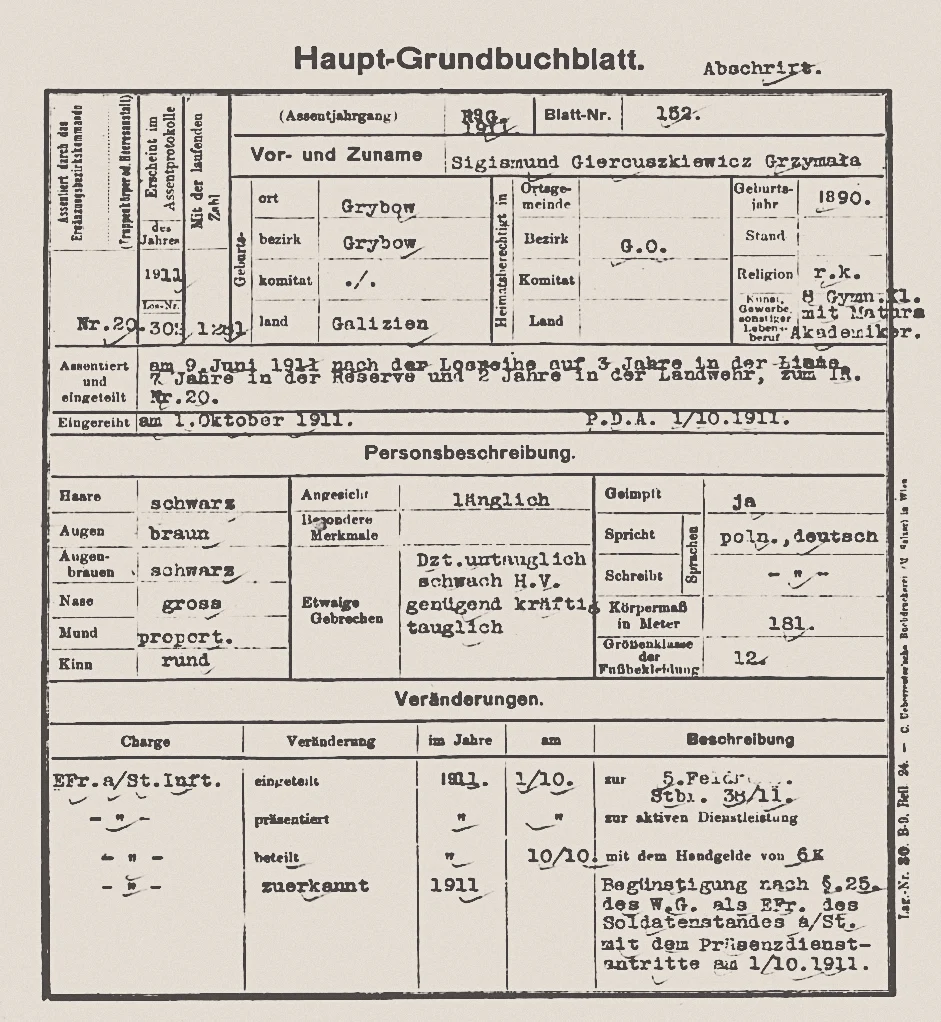
Reading the first page
- Birth and place
- Geburtsjahr: 1890; Grybow appears as both birthplace and district, with Galizien as the crown land. The sheet gives a birth year, not a complete birth date.
- Religion
- r.k. indicates Roman Catholic. Together with the locality, this is a useful lead when choosing parish registers to search.
- Education and occupation
- The entry records eight gymnasium classes with Matura, the school-leaving examination, and uses Akademiker. This points towards an academic background, but does not name a university, subject or completed degree.
- Languages
- poln., deutsch records Polish and German. A language entry describes recorded ability; it should not be treated as a nationality certificate.
- Appearance
- Black hair and eyebrows, brown eyes, a long face and a round chin. The height is written as 1·81, or 1.81 metres. Geimpft: ja records vaccination.
- Entry into service
- The page records acceptance on 9 June 1911 and reporting for service on 1 October 1911. These are distinct administrative stages, not two competing enlistment dates.
The continuation: promotions, mobilisation and decorations
The columns headed Charge, Veränderung, im Jahre, am and Beschreibung record rank, change, year, day/month and explanation. The continuation is where a static description becomes a dated service history. Read across each row: ditto marks carry information down from earlier entries.
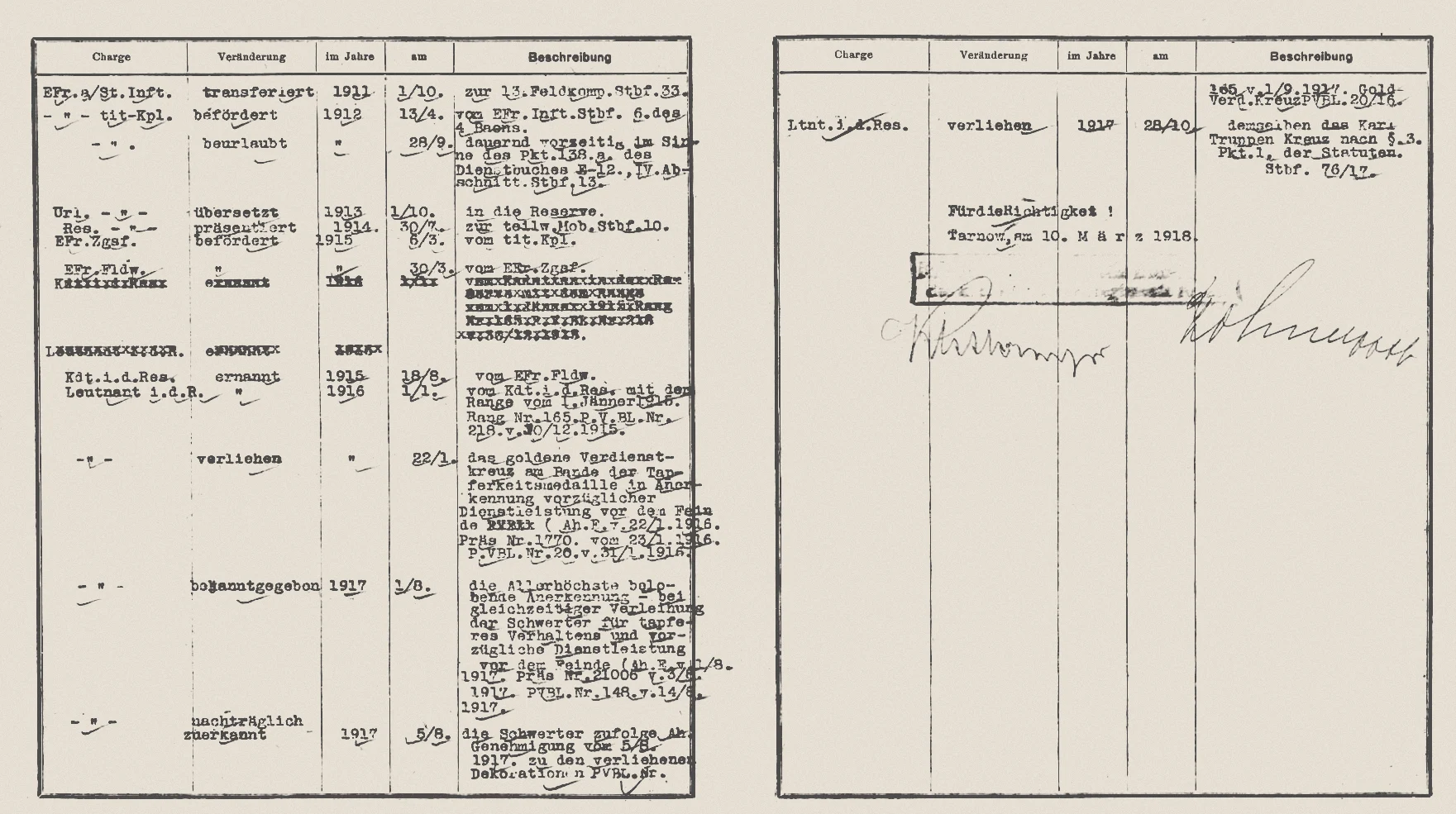
A timeline reconstructed from the visible entries
- 1911Acceptance and reporting for service
The first page records 9 June and 1 October. The continuation includes a company transfer on 1 October. The abbreviation EFr. refers to the one-year volunteer category, rather than a career officer appointment.
- 1912A promotion, then leave
An entry dated 13 April records promotion to tit. Kpl., a titular corporal rank. The 28 September entry records leave; leave is not automatically a final discharge.
- 1913-1914Reserve status and wartime mobilisation
A transfer into the reserve is recorded on 1 October 1913. The next year contains a reporting-for-service entry dated 30 July 1914, linking the pre-war record to wartime service.
- 1915-1916Progression towards officer rank
The surviving entries include Kdt. i. d. Res., reserve cadet, in August 1915 and Leutnant i. d. R., reserve lieutenant, in January 1916. The description also refers to seniority: appointment, entry and seniority dates should be distinguished.
- 1916A Golden Merit Cross
The entry dated 22 January records the goldene Verdienstkreuz am Bande der Tapferkeitsmedaille, the Golden Merit Cross on the ribbon of the Bravery Medal, for excellent service before the enemy. The ribbon wording does not make the award a Golden Bravery Medal.
- 1917Further recognition and the Karl Troop Cross
Entries refer to the highest commendation and swords, including a subsequent addition to an already awarded decoration. The right-hand page records the Karl-Truppen-Kreuz on 28 October 1917. These are leads for checking award notices and any surviving supporting papers.
- 10 March 1918The copy is certified at Tarnów
Für die Richtigkeit! means a certification of correctness. The place and date establish when and where this copy was certified. They do not, by themselves, locate the soldier at the front on that day.
What makes this useful for family history?
The combination of a surname, Grybów, a birth year and religion gives a more precise identity to test against birth and school records. Education and languages add civilian context; reserve status and promotions explain changes that may otherwise appear puzzling in photographs or family stories.
What these pages do not establish
They do not name his parents, spouse or children, supply a full birth date, or give a day-by-day account of battles. A decoration entry is evidence of an award recorded in the sheet, rather than a complete account of the action behind it. No archive of origin is assigned to these supplied scans without a verified provenance.
How to handle abbreviations, crossings-out and missing details
Preserve the original wording before expanding a military abbreviation. i. d. R. or i. d. Res. indicates reserve status; Ltnt. or Leutnant identifies the lieutenant rank. Unit abbreviations and administrative references need to be read in their contemporary context.
Some promotion entries on these pages have been cancelled. A crossed-out rank should not be presented as an additional confirmed promotion. Compare the uncancelled entries and their dates first. Likewise, a blank marital-status field is not evidence that a man was unmarried, and an abbreviated medical note should not be expanded into a modern diagnosis without a secure reading.
A careful report separates a transcription, an English explanation and conclusions supported by other sources. This walkthrough explains selected legible entries; it is not a complete diplomatic transcription of every annotation.
Landsturm records: a German-Polish call-up card from Galicia
Document example / Military obligation / Galicia
A local reporting point, recorded in two languages
Austro-Hungarian army records include more than a soldier’s career sheet. This bilingual card connects a named man with a home municipality and a place where he was instructed to report if the Landsturm was called up.
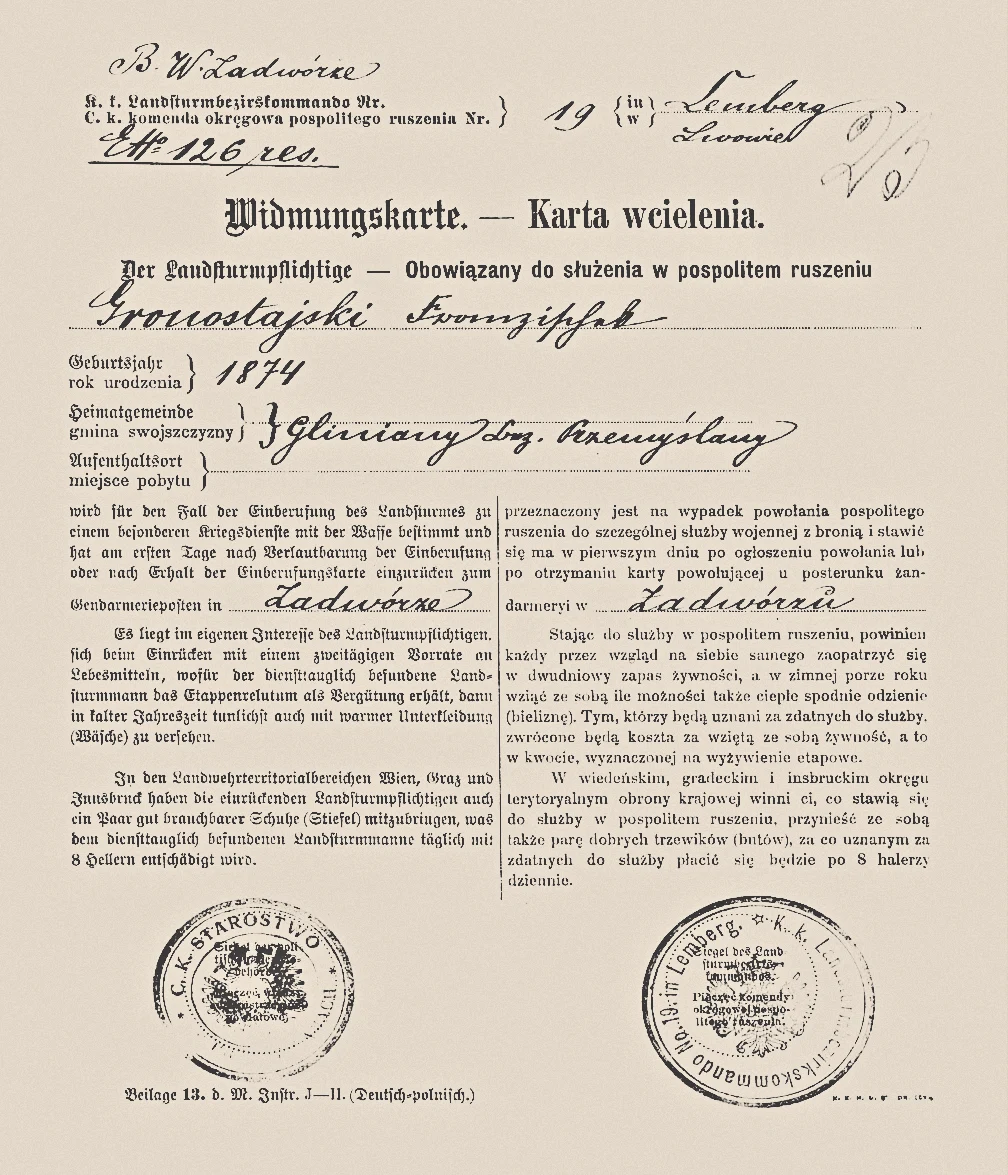
What to read on the card
- The document’s purpose
- Widmungskarte is paired with the Polish title Karta wcielenia. The printed line identifies the holder as obliged to serve in the Landsturm, rendered here as pospolite ruszenie. Treat this as a record of military obligation and assignment.
- The birth year
- Geburtsjahr / rok urodzenia is completed as 1874. It is a direct identity clue, but the card does not provide a full birth date.
- The home municipality
- Heimatgemeinde / gmina swojszczyzny reads Gliniany, followed by a Przemyślany district designation. Home affiliation should be distinguished from birthplace and current residence; the separate residence field is not completed.
- Where to report
- The handwritten entry beside Gendarmerieposten and Polish posterunku żandarmeryi names Zadwórze. This is a reporting point, rather than a documented battlefield or proof of residence there.
- Language and official marks
- The German and Polish columns express the same administrative instructions. The stamps and the reference to Landsturm district command No. 19 in Lemberg/Lwów help identify the military administrative context; they do not supply a complete service history.
A glimpse of mobilisation logistics
The printed instructions require a two-day food supply and refer to warm clothing in winter. A further paragraph concerns suitable footwear in specified Landwehr areas. These are standard instructions on the form, not evidence that this particular man brought those items or received reimbursement.
How to use the place names
Keep Gliniany, Przemyślany, Zadwórze and Lemberg/Lwów as separate entries in the research notes. They describe home affiliation, district, reporting point and command location. Historical spellings can help search Galician military records and local archive catalogues.
Austrian census records: military-service questions in 1934
Supporting source / Austrian census / 22 March 1934
Military questions inside a household record
This Sonderblatt, or supplementary sheet, belongs to the Austrian census of 22 March 1934. It shows why a search for military service can extend into civilian records after the end of the Habsburg monarchy.
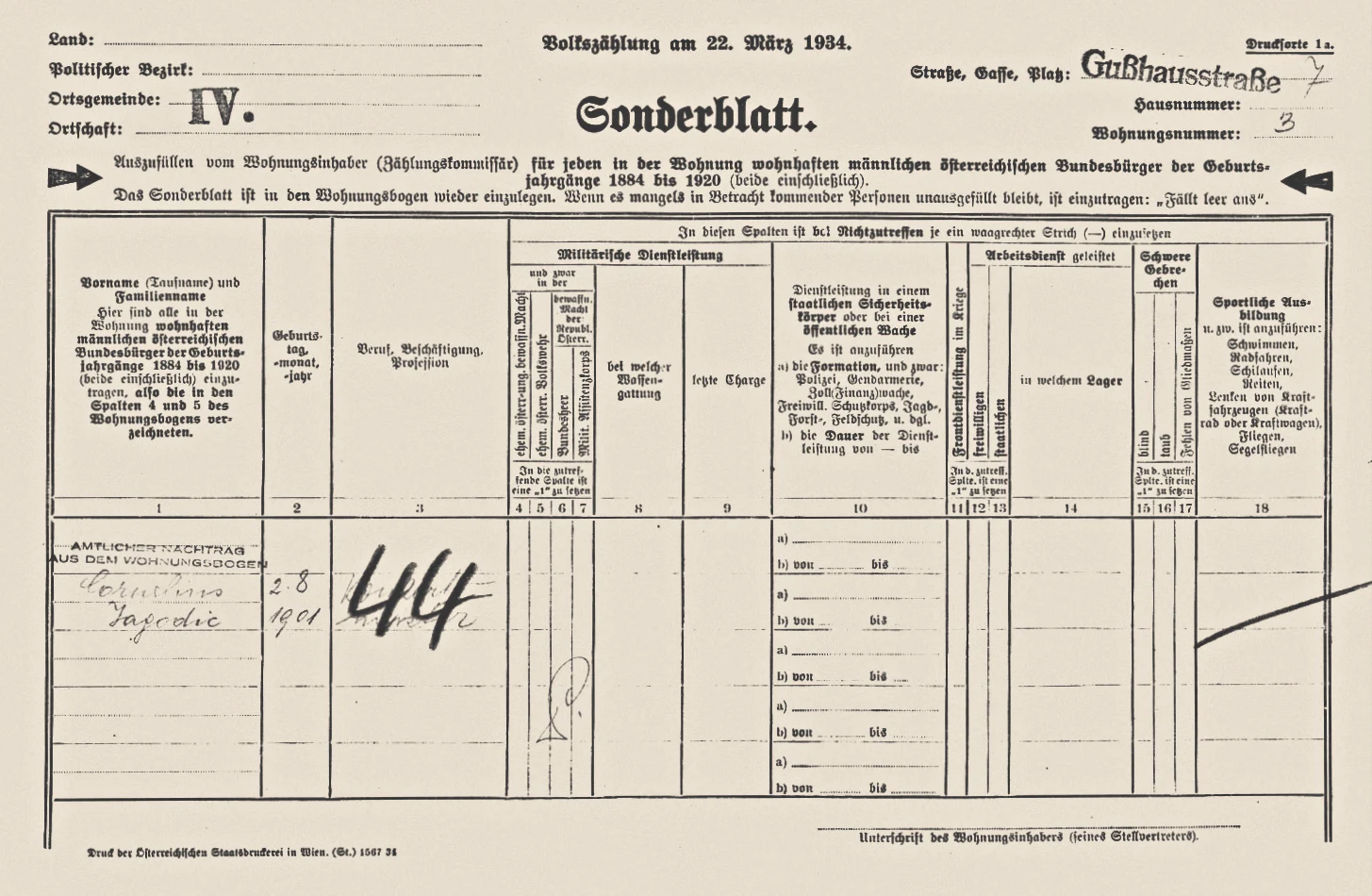
Identity and household clues
The left-hand columns ask for name, date of birth and occupation. The visible birth entry is 2 August 1901. The address line reads Gußhausstraße, with 7 entered at its end, and the dwelling number is 3. An official note refers to an addition from the household schedule, making that accompanying schedule an obvious record to seek if it survives.
Who the sheet was intended to cover
The printed instructions concern male Austrian citizens living in the dwelling who were born between 1884 and 1920, inclusive. They also tell the compiler to return the supplement to the household schedule. This defines the form’s intended coverage, rather than a roster of men known to have served.
Military information these columns could contain
- Service organisation, branch and last rank
- The military-service group distinguishes different forces and asks for Waffengattung, the branch of service, and letzte Charge, the last rank. A completed answer could connect a civilian identity with a military organisation.
- Service in security organisations
- A separate group asks about service in a state security body or a public guard, naming organisations including police, gendarmerie and customs guards. These questions extend beyond an army service record.
- Wartime service, labour service and injuries
- The headings ask about front-line wartime service, voluntary or compulsory labour service and the camp concerned, and serious disability, including war-related disability. A heading alone supplies no evidence that the named person experienced any of these.
- Skills useful beyond the household
- The sporting-training column lists examples such as swimming, cycling, skiing, riding, motor driving, flying and gliding. The printed list shows the scope of the questionnaire; it is not a list of this person’s abilities.
The date and historical census context are confirmed by Statistics Austria’s historical census overview. That source does not establish where this individual sheet is held or whether a complete household file survives.
Austrian identity and registration records: Persons- und Melde-Nachweis
Document example / Identity and registration / Bukovina
Parents, birthplace and a signature on one sheet
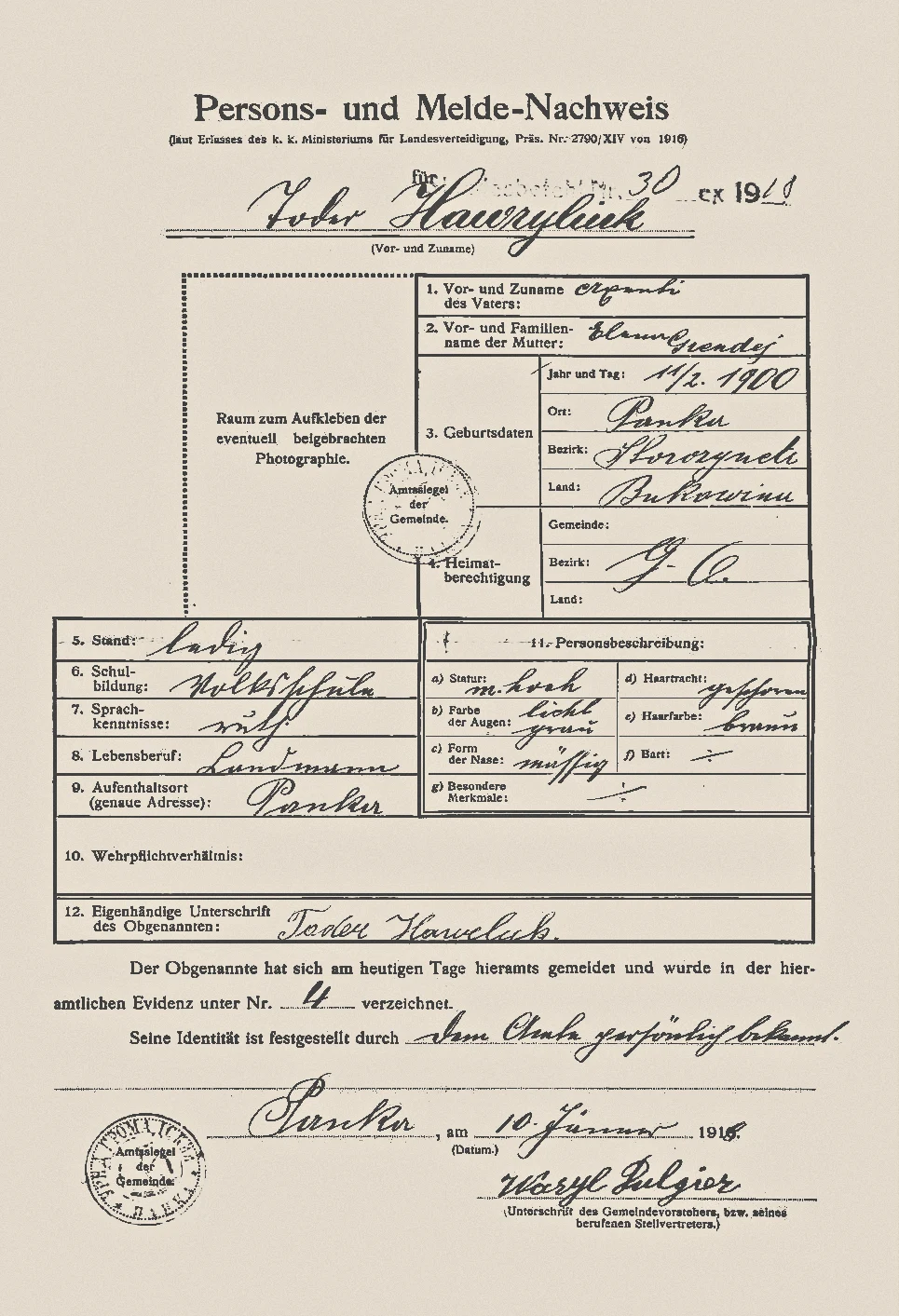
A Persons- und Melde-Nachweis records a person’s identity and registration. This example brings together family details, a farming occupation, a physical description and a handwritten signature. It shows how a document associated with military administration can supply leads for a much wider family-history search.
What this document can reveal
- Name and signature
- The name appears to read Todor Hawryluk. The signature in field 12 provides a second handwritten example to compare. Keep the recorded spelling in your notes and check it against independent family records before adopting a modern spelling.
- Parents’ names
- The first two fields identify the father and ask for the mother’s given name and family name. Both are completed. This is valuable information for distinguishing people with similar names and finding a corresponding birth or baptism entry. The handwritten parent-name readings should be checked before entering them into a family tree.
- Birthplace and district
- The birth entry reads 11 December 1900, with Panka as the place, Storozynetz as the district and Bukowina as the crown land. Bukovina is a different regional context from the Galician examples above. Preserve the historical place names when searching catalogues.
- Residence and home affiliation
- The residence field also reads Panka. The separate Heimatberechtigung group concerns municipal home affiliation; it must not automatically be treated as another birthplace or residence entry. The fields should be read separately, including blanks and abbreviated marks.
- Marital status, school and occupation
- Ledig means unmarried. Volksschule refers to elementary schooling; it does not identify a particular school or establish how many classes were completed. Landmann indicates a farmer. The abbreviated language entry needs a firmer reading before assigning a language or ethnicity.
- Appearance and identifying features
- The physical-description panel records a stature description, light-grey eyes and brown hair, with further fields for nose, hairstyle, beard and distinguishing marks. The stature entry is abbreviated and supplies no height in centimetres. A dash should not be expanded into a detailed claim about appearance.
Why a genealogist would want this sheet
A name, birth date, parents and locality can connect a registration certificate with a parish register or later identity papers. The signature offers another comparison point. For descendants researching from Britain, these details may help test whether a family document relates to the right ancestor rather than a namesake.
Keep three kinds of date apart
The printed heading cites a Ministry of National Defence order from 1916. The handwritten certification appears to read 10 January 1918, while a mark near the name includes 1920. A form-authority date, a completed certification and a later administrative reference have different meanings. Check the original before constructing a chronology from them.
The military connection is supported by contemporary usage: a notice in Głos Narodu, 12 April 1916, page 8, lists a Persons- und Melde-Nachweis among the documents men were to bring to a Landsturm examination. That notice explains the document type’s context; it does not identify the man in this scan or establish that he attended an examination.
How to follow the clues from a service sheet
A service sheet is most useful when each detail leads to a specific next check. For a family researching from Britain, it can connect an earlier Galician generation with later family papers, without assuming that every person with a similar surname is the same man.
- Confirm the identity. Compare the recorded name, birthplace, year and religion with a birth or baptism entry. Search German and Polish forms of the given name and allow for missing diacritics.
- Separate the places. Record birthplace, home affiliation, recruitment district, unit location and place of certification individually. They answer different questions.
- Build a dated service table. Keep acceptance, reporting for duty, leave, reserve transfer, mobilisation and promotion as separate events. Include later corrections.
- Check education and awards. A Matura entry can suggest school records. A named decoration and its notice references can provide another route to corroboration; the supporting material may not survive.
- Add regimental context carefully. A unit history can explain where a formation fought. It does not establish that this particular soldier took part in every operation, especially after a transfer, leave or hospital stay.
What Austro-Hungarian army records can tell you
Austrian military records (or Austro-Hungarian army files) cover several document types. The surviving information varies by period, military status and archive. A personal service sheet may be detailed, while a casualty-list entry may contain only a few identifying facts. No single document should be expected to supply every item listed below.
Each document type reflects a slightly different purpose: conscription, service tracking, promotion, or pension entitlement. Together, they can paint a vivid picture of an ancestor’s life between enlistment and discharge.
1. Personal and Biographical Details
Personal service sheets may contain biographical fields and a Personsbeschreibung or Personalbeschreibung section for physical characteristics. Depending on the form, you may find:
- Full name and any known variations (surname spelling often differs).
- Date and exact place of birth - sometimes down to parish or district level.
- Religion (Roman Catholic, Greek Catholic, Jewish, Protestant, etc.).
- Marital status and number of children.
- Occupation before enlistment.
- Literacy and education level.
- Physical description - height, hair and eye colour, distinguishing marks.
2. Military Service Information
Service-history entries may record:
- Regiment and battalion numbers
- Enlistment and discharge dates.
- Training location and initial posting.
- Campaigns or theatres of war served (e.g. Bosnia, Serbia, Galicia, Italy).
- Transfers between units or branches (infantry, artillery, cavalry).
- Promotions and ranks attained.
- Awards or commendations received (e.g. Bronze Medal for Bravery).
Many records also note whether the soldier was active, on reserve duty, or permanently discharged, which helps to track their movements during wartime.
3. Health, Injury and Discharge Notes
Some personnel, hospital, casualty or discharge records contain health-related information, such as:
- Hospital admissions or field injuries.
- Illnesses contracted during service.
- Accidents or wounds in battle.
- Discharge reason - illness, injury, end of term, or death in service.
In cases of death, the file may include the place and date of burial, often recorded by the local military parish (Militärpfarre). These details can be cross-checked with wartime casualty lists (Verlustlisten), which were published throughout WW1 and are now digitised by the Austrian National Library.
4. Family and Next-of-Kin Details
Family details are more likely to appear in supporting personnel, pension or next-of-kin papers than in every service sheet. Depending on the surviving record type, you may find:
- Parents’ names and residence (often in Galicia or another crown land).
- Name and address of wife or legal guardian.
- Beneficiary for pension or death compensation.
This part of the record can provide rare genealogical links - especially when no other civil record for the family survives.
Need Help Finding Austrian Military Records?
Researching Austrian and Austro-Hungarian military records involves identifying the correct collection, interpreting historical German and comparing entries across sources. Archive enquiry, copying and certification procedures differ; check the relevant repository rather than assuming a single rule for overseas applicants.
Our team specialises in locating, verifying, and translating original Austrian military service records - whether for genealogical research, citizenship confirmation, or historical verification. We work directly with the Kriegsarchiv in Vienna, Polish State Archives, and regional repositories to obtain genuine and verifiable copies of documents.
We can:
✔ Locate individual soldier records across Austrian and Polish archives
✔ Identify the correct regiment or recruitment district based on birthplace
✔ Request available record copies, with certification requirements agreed separately
✔ Translate documents from German, Polish, Latin or old Gothic script
If your ancestor served in the Austro-Hungarian army, a focused investigation can establish what survives and explain the evidence in English. Findings depend on the surviving collections; a complete personnel file or certified copy cannot be guaranteed.
Where to search Austrian military archives
Austrian military records are not all in one place.
While most English-language sources point straight to Vienna, the truth is more complex - the archives of the former Austro-Hungarian Empire are scattered across several modern countries, including Austria, Poland, the Czech Republic, Hungary and Ukraine.
Understanding this division is key to finding the right file.
1. The Austrian State Archives - Kriegsarchiv (Vienna)
The Kriegsarchiv in Vienna, part of the Austrian State Archives, is the main repository for the military records of the Imperial and Royal Army (k.u.k. Armee), covering roughly 1740-1918.
It houses millions of pages of documents relating to regiments, officers, and enlisted men from all crown lands - including Galicia.
Main collections include:
- Musterlisten und Standestabellen - annual regimental rolls listing all soldiers.
- Grundbuchblätter - personal service sheets, sometimes with physical descriptions.
- Offiziersakten - detailed files for officers.
- Militärkirchenbücher - military parish books (baptisms, marriages, burials).
- Verlustlisten - wartime casualty lists.
The Kriegsarchiv provides guidance on where to search but does not undertake a family-history investigation for you. Its research guidance explains how to identify relevant material for consultation in person or online.
2. State Archives in Poland (Archiwa Państwowe)
For Galician ancestors, check the relevant Polish archive catalogues for local recruitment and administrative records. Coverage varies by locality and year; a modern archive name alone is not proof that a soldier’s individual file survives there.
Galician service sheets in Lviv
The Austrian State Archives directs researchers of Galician birth cohorts from 1865 onwards to surviving service sheets in the Central State Historical Archives of Ukraine in Lviv. Project Wojak provides a surname index to digitised material and links to scans. This is a useful starting point, not a complete index of every Galician soldier. See the official archive guide for service between 1868 and 1918.
3. Church and Municipal Archives
Church archives - especially Roman Catholic and Greek Catholic diocesan archives - may hold military parish registers (Militärkirchenbücher) documenting baptisms, marriages and deaths of soldiers and their families.
Municipal archives may also contain lists of local men conscripted into the imperial army, war memorials, and records of post-war benefits or pensions.
These sources can complement official military files, particularly for lower-ranking soldiers whose central records have been lost.
In practice, the first task is to match the person, period and home affiliation to a surviving collection. The answer may involve Vienna, a Polish repository or Lviv; searching Vienna alone can miss the relevant record.
WW1 Austro-Hungarian Military Records
For a search into the Austro-Hungarian army in WW1, distinguish a personnel record from a casualty list or a history of the formation. They answer different questions about an individual soldier. Millions of men from southern Poland and western Ukraine were mobilised between 1914 and 1918, leaving behind traces in wartime casualty lists, regimental records and prisoner-of-war files.
The Verlustlisten (Austro-Hungarian casualty lists), now digitised by the Austrian National Library, are often the starting point for WW1 research. They record names, ranks, regiments and fates of soldiers who were wounded, missing or killed in action. Even when no personal service file exists, these lists - combined with surviving regimental diaries or conscription rolls preserved in Vienna, Kraków or Lviv - can help reconstruct a soldier’s movements and identify the unit he served with.
How to Identify the Right Military Record
Start with the name, birth date or year, birthplace and any recorded home affiliation (Heimatzuständigkeit). Add a unit, service number or dated photograph if available. Recruitment districts help narrow the search, but do not establish an individual’s complete service history.
1. Start with the Place of Birth or Residence
Birthplace, legal home affiliation and recruitment district can be different. Before choosing a collection:
- Identify the town or village from civil or church birth records.
- Use historical maps or the Słownik Geograficzny Królestwa Polskiego to confirm which county (powiat) and district (cyrkuł) the settlement belonged to under Austrian rule.
- Cross-reference that district with the regimental recruitment list (available in many genealogical guides).
2. Match the District to Its Regiment
Check a contemporary recruitment or regimental reference for the relevant year. Districts and unit designations changed, and a soldier could transfer between formations. A birthplace suggests a route to investigate; a service-sheet entry or other individual record is stronger evidence of the actual unit.
Copy the full unit designation, not just its number. Distinguish the common army from the Austrian Landwehr and Hungarian Honvéd. Use a recorded unit to seek the appropriate personnel material or historical context, while checking whether the relevant series covers your ancestor’s service years.
3. Estimate the Service Period
If you don’t know the exact service years, use the birth date:
- Men born 1850-1880 → likely served 1870-1900.
- Men born 1880-1900 → served around 1900-1918, including WW1.
This helps target the correct archival series - the appropriate series depends on the period, home affiliation and military status, rather than a universal 1880 cut-off.
Tip: If you’re not sure about your ancestor’s exact date and place of birth but still want to look for their military records, have a look at the section on our website about Polish birth records too - it might help you fill in the missing details.
Austrian military records online: indexes, scans and archive access
To search Austrian military records online, begin with the collection route for your ancestor’s birthplace or home affiliation and birth year. For Galician military records, Project Wojak provides a free surname index with links to digitised documents. Follow the link to inspect the whole record, including continuation pages; an index is a finding aid, not a substitute for the scan.
The Austrian State Archives’ personnel-record guide links to the relevant archive catalogue descriptions and online collections, including FamilySearch where applicable. Some image access may require a user account or depend on the collection’s viewing conditions. Check the linked collection rather than assuming every Austrian military record is freely viewable from home.
If you are researching from abroad, there are several practical realities:
- Online access varies: some collections have scans and indexes, while others require catalogue research or reading-room consultation.
- Follow each archive’s current request, language and payment instructions; keep the name and locality in the forms found in the original records.
- Undigitised files may require on-site consultation or an archive copying request.
- Access and reproduction conditions depend on the repository and document type; the year 1900 is not a universal access boundary.
That’s why many people choose to appoint a local genealogical researcher who can identify the correct archive, file a formal request and obtain verified copies or photographs of the record.
Sources and further reading
- Document example: five reproductions supplied by the owner of The Polish Genealogist. Selected visible entries are explained above; the archive of origin has not been independently verified.
- Austrian State Archives: researching officers, NCOs and soldiers, 1868-1918 - collection routes, home affiliation and Galician material.
- Kriegsarchiv: what the archive can and cannot do - guidance and researcher responsibilities.
- Austrian State Archives: tracing wartime deployments - limits of surviving regimental material.
- Project Wojak - an index and scan links for surviving Austro-Hungarian records.
- Statistics Austria: historical censuses - confirms the census date of 22 March 1934.
- Głos Narodu, 12 April 1916, page 8 - contemporary notice naming the Persons- und Melde-Nachweis among documents required for a Landsturm examination.