Polish Land and Mortgage Registers
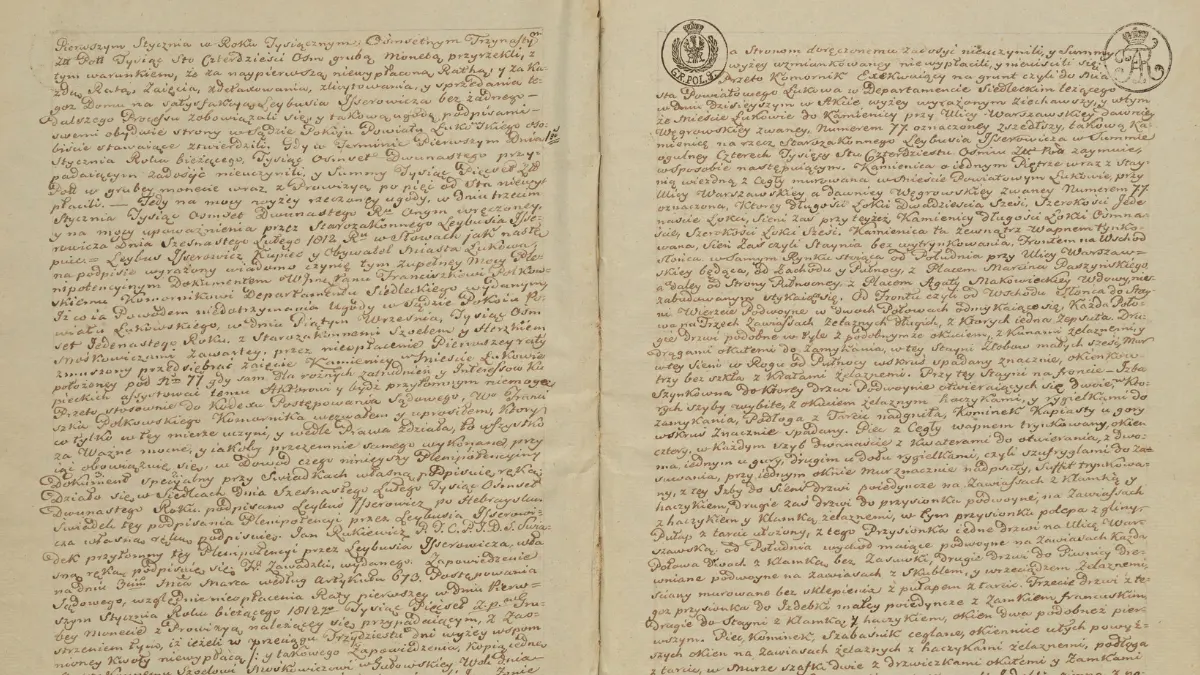
Land and mortgage registers (księgi wieczyste, and their older predecessors, the księgi hipoteczne) are worth searching whenever a family story involves a farm, a town house, an inheritance quarrel or a forced move. They seldom name a whole family, but they tie a named person to a precisely identified property and cite the deeds, inheritance decisions and court files on which each entry rests. Those cited documents are where relatives, heirs and addresses usually appear.
What a księga wieczysta records
A księga wieczysta is the official register of the legal status of one piece of real property. Today the registers are kept by the land and mortgage register divisions of Polish district courts (sąd rejonowy, wydział ksiąg wieczystych). They exist to show who owns the property, on what basis, and what charges or restrictions such as mortgages and easements burden it.
For genealogy the register is a summary. An entry may say that ownership passed “by inheritance” or “by notarial deed”, and the detail sits in that underlying document: a list of heirs, their relationship to the deceased, their places of residence.
The modern system does not reach back unchanged through every period. Before the Second World War the Russian, Prussian and Austrian partitions each kept property records under their own law, and later border changes moved many files. Older property papers can therefore be in a court, a state archive or an administrative collection.
Historical land ownership in Poland
Rural family history in Poland crosses several legal systems: the partitions, the land reforms, war damage, the border changes after 1945 and later administrative reorganisations. Each affected where property records ended up, which language they were written in and which institution holds them now.
Family land was not always owned the way a modern reader expects. A farm might be registered to one spouse, one sibling or a single heir, and ownership could change through inheritance divisions, debt, forced sales or administrative decisions. Tracing it usually means rebuilding a chain of title and checking each link against civil or church records.
Property evidence is most useful when the surname is common or several villages share a name, because it shows which locality belonged to your family.
Records of noble estates (manorial records)
Families connected with the nobility or with large estates may find manorial and estate papers rather than, or alongside, land registers. “Manorial records” covers estate accounts, tenant lists, inventories, manorial court books, correspondence and administrative files.
They help in two ways. They document the owners and heirs of an estate, which matters for noble and landed lines. More often for ordinary families, they mention people who lived and worked on the estate: leaseholders, craftsmen, servants and peasant households tied to the land for generations.
Estate papers are scattered, often incomplete, and written in older hands and legal language, not always in Polish. Being associated with an estate is also not the same as owning a parcel of it. We use manorial sources to support conclusions about identity and place, and confirm them in the metrical registers (birth, marriage and death entries) and, where they survive, in court and notarial files.
How to trace family land history
Start from what can be proven: a confirmed person with approximate dates and a confirmed village or town. A mention of a house or farm in family papers does not by itself show ownership.
The research then usually covers:
- the correct locality and the district and court it belonged to at the time, which decides where the records are kept;
- whether the family were owners, co-owners, leaseholders or occupants, since each leaves a different paper trail;
- the documents the property entries lead to: inheritance proceedings, notarial deeds, court decisions, and sometimes tax or cadastral records.
Searches from abroad often stall on a mistranscribed place name or on the assumption that everything sits in one office. Property documentation for a single farm may be split between a court, a state archive and a local authority. We identify the right holders, request the files in Polish and read them, and keep the search on records that can actually be obtained.
Land surveying maps and registers
Cadastral maps and land registers matter when the family story turns on a particular parcel, farm or homestead, or when the same surname occurs in several neighbouring villages and the lines have to be told apart by geography.
Depending on the system and period they show boundaries, parcel numbers, land use and sometimes owners or occupants. Their main use is to turn a place in a story into a legally identifiable property, which can then be followed into court registers or notarial deeds.
Maps are not self-explanatory. Parcel numbers were changed, place names shifted, and modern addresses rarely match old parcels. Reading them means lining up historical administrative divisions, later renumbering and the references in court or notarial records. A misidentified parcel leads the whole search to the wrong family, so this step is worth doing carefully.
Accessing mortgage files in local courts
Land and mortgage files belong to the jurisdiction of the local district court. The question is not only where to ask but what may legally be released and in what form. Some information can be viewed or confirmed, while copies of the underlying documents may be restricted, especially where they contain personal data of living people.
The register entry points to a supporting document, such as a notarial deed, court decision or inheritance ruling, and that document may be kept under different rules or in another repository. Older parts of a file are often already in a state archive while newer parts remain at the court.
Requests must be made formally, in Polish, with the file correctly identified. We confirm the jurisdiction and file references, request what can be released, and use it to reach the inheritance and notarial records that usually say more about the family than the register itself.