Pre-War Polish Passport and ID Applications

An old Polish passport file can put a face to a name and reveal a journey that never reached the family story. For descendants researching from Britain, photographs, signatures, occupations and places can connect an ancestor’s Polish identity with later records abroad. Our commissioned family-history research follows those clues through surviving archival records and explains the findings in English.
The examples below show three distinct sources: an application made in 1920, a passport dated 1921 and a passport register recording several travellers. Read them together to see what each source adds, while keeping an intended journey separate from evidence of an actual arrival.
Old Polish passport records: pre-war applications, booklets and registers
Interwar passport research reaches beyond the passport booklet itself. An application may preserve an attached photograph, a declared birthplace, residence, occupation, travel companions and guarantors. An issued passport can add official certification, serial numbers and travel conditions. A register may record issuance, fees and collection even when the individual application has not been located.
A Polish passport application with a photograph: Piotrków, 1920
Document example 01 / Application / Piotrków
A tailor, a portrait and plans to join family abroad
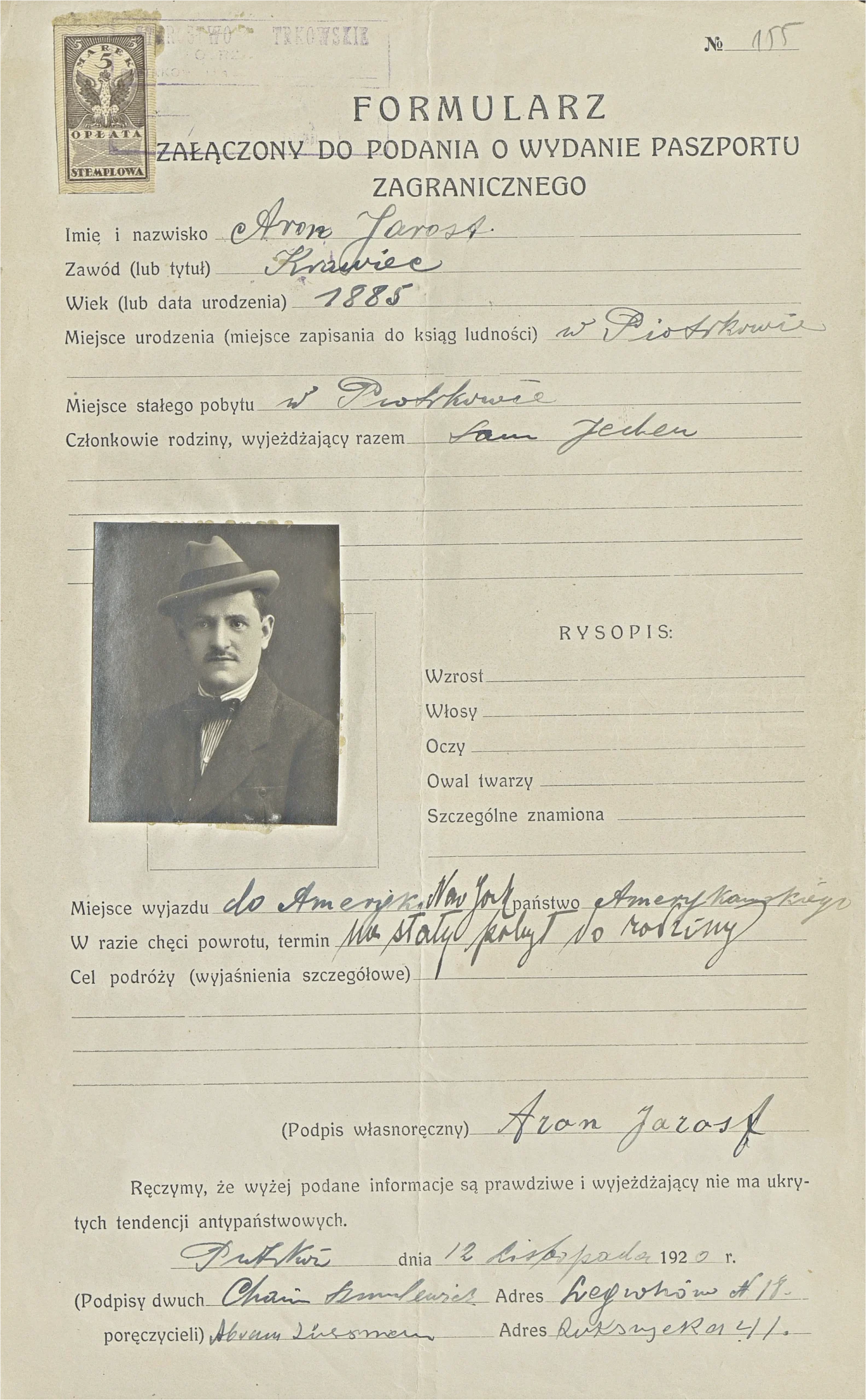
This form was attached to an application for a foreign passport. The name appears to read Aron Jarosz. Rather than a list of dates alone, it preserves a portrait, an occupation, a signature and a statement about the intended move.
What the entries tell us
- Birth and residence
- The form gives 1885 and Piotrków in both the birth/population-registration field and the permanent-residence field. The first field combines two possible concepts in its printed label: compare it with a birth entry before treating it as independent proof of birthplace.
- Work and household
- Krawiec means tailor. The entry for accompanying family reads sam jeden: he intended to travel alone, which says nothing either way about a wife or children at home.
- Destination and intention
- The destination names America and New York. A further entry states na stały pobyt do rodziny: for permanent residence, to join family. This gives a research question about relatives abroad, without identifying those relatives.
- Photograph and signature
- The portrait shows the applicant in 1920, and his signature can be compared with later papers, alongside names, dates and places.
- Guarantors and addresses
- Two guarantors signed the declaration at the foot of the form, with address entries. Their names may suggest associates worth investigating, but the declaration does not establish a family relationship. Check the handwriting before adding them to a tree.
Inside a 1921 Polish passport: portrait, description and New York destination
Document example 02 / Passport booklet / Polish and French
Compare the application with the issued document
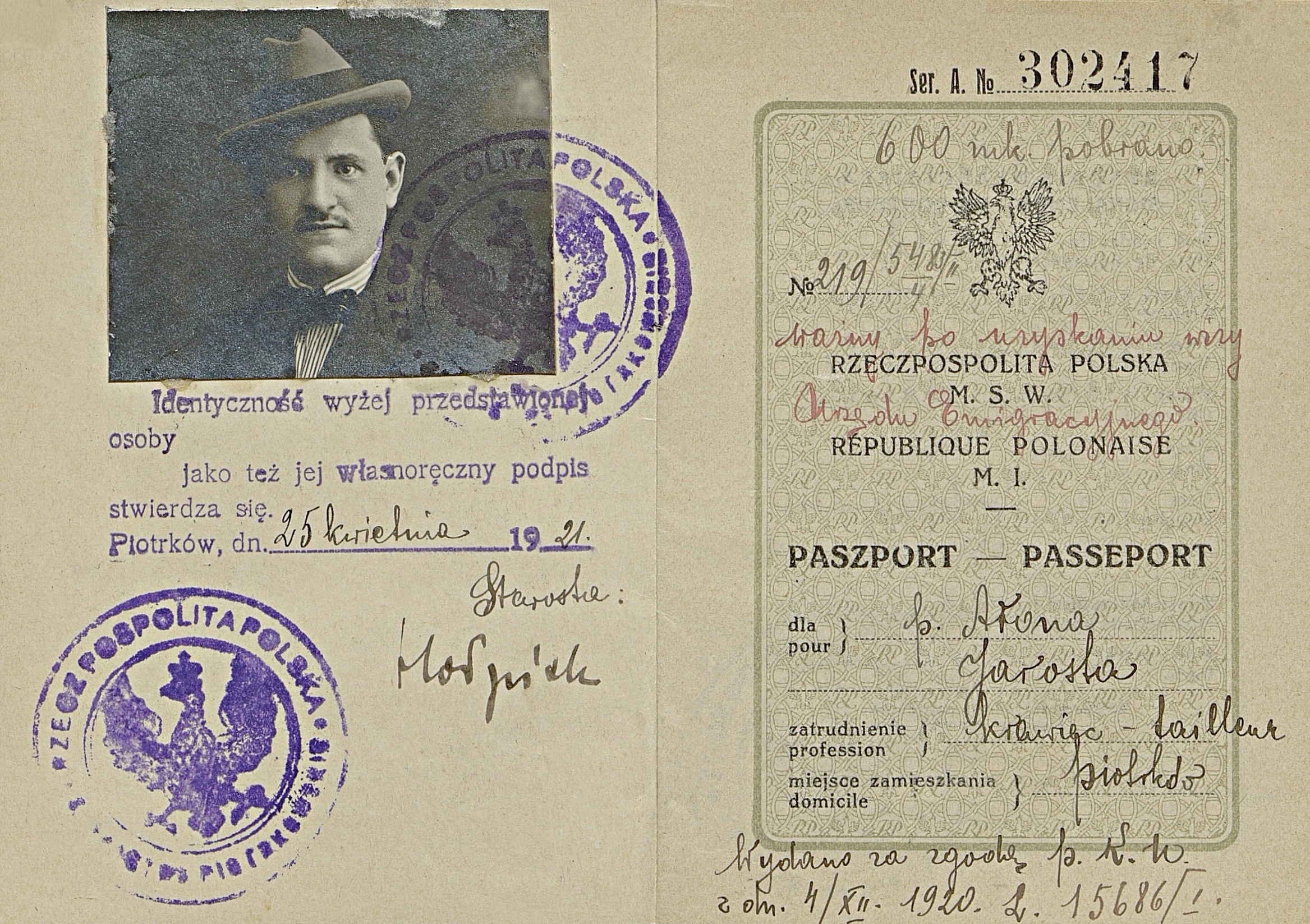
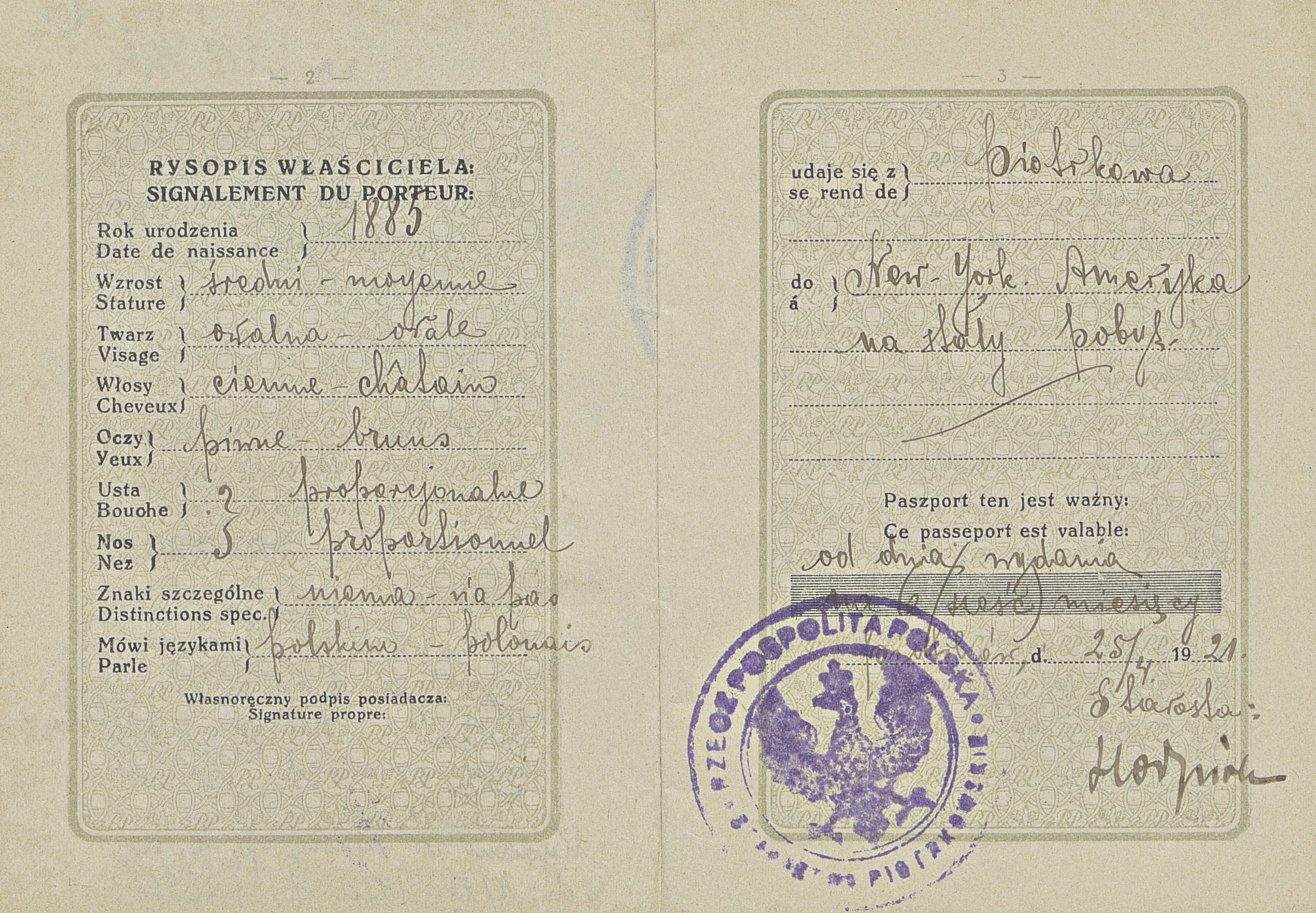
The supplied passport pages show a matching portrait and overlapping identity details. These are strong comparison points with the application above, though the exact archival sequence should still be checked against the complete file. The booklet adds official seals and a completed physical description.
What the entries tell us
- Repeated identity clues
- The booklet gives 1885 as the birth year, Piotrków as the residence and krawiec / tailleur as the occupation. Agreement across several fields matters more than a single matching surname.
- Physical description
- The entries describe medium stature, an oval face, dark hair and brown eyes. The height is descriptive rather than a measurement in centimetres. No distinguishing marks are recorded in the relevant entry.
- Language
- The language field records Polish, with the French equivalent alongside it.
- Route and validity
- The travel page states a journey from Piotrków to New York, America, for permanent residence. A handwritten validity condition is also present. These entries describe the document’s authorised or intended use, not proof of a completed voyage.
- Serial numbers, stamps and dates
- The printed series number A 302417, other handwritten administrative numbers and the official seals can help compare related papers. Record each number with its label; a serial number is not automatically an archive reference.
A Polish passport register: Vienna trips and emigration to Brazil in 1921
Document example 03 / Passport register / August 1921
One page, several very different journeys
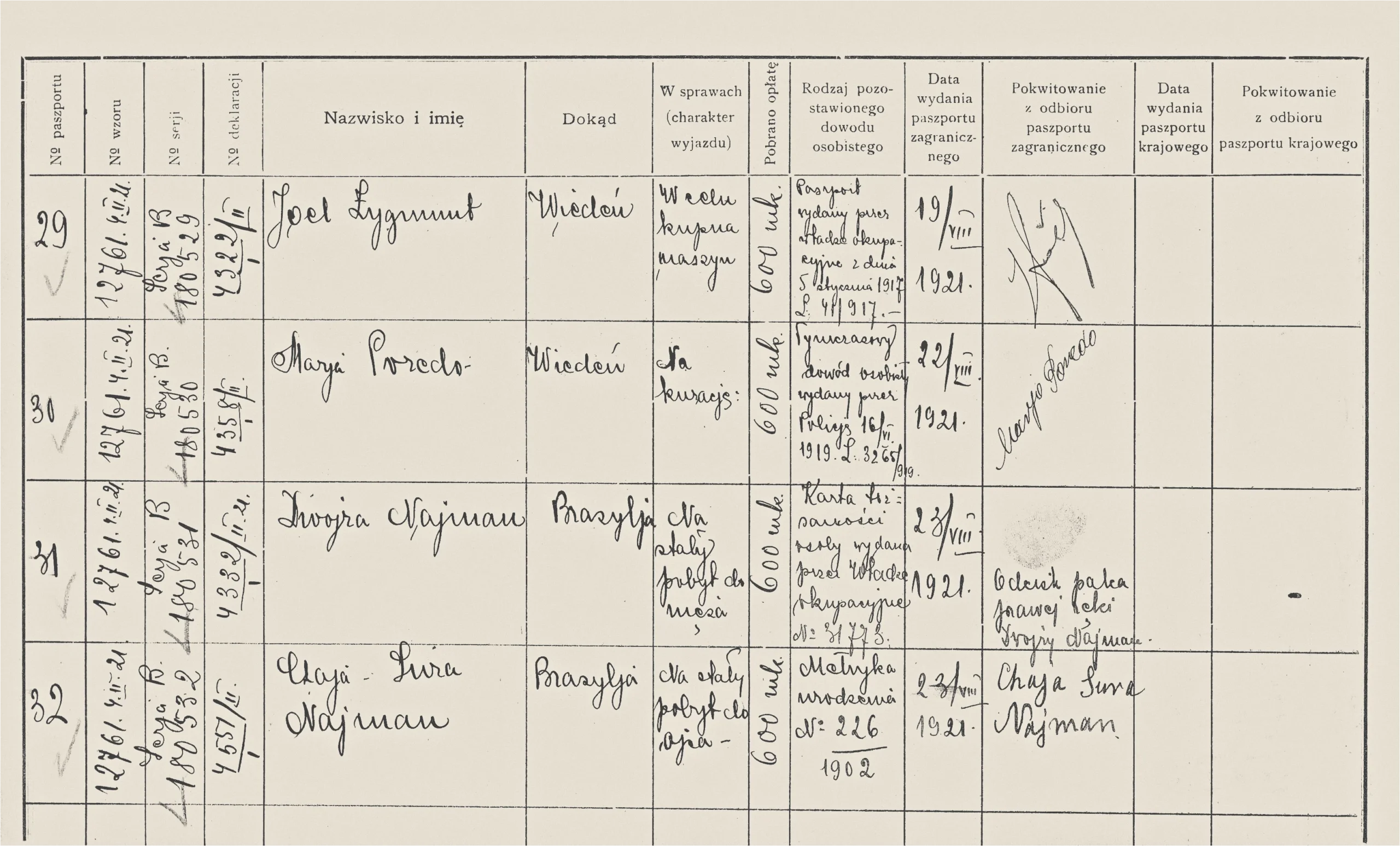
A książka paszportowa is an administrative register, distinct from a personal passport booklet. This page records several travellers, with columns for destinations, travel purposes, fees, documents left with the office, issue dates and receipts.
Trade and treatment in Vienna
One Vienna entry states that the purpose was to buy a machine; another records travel for treatment, na kurację. A destination alone cannot tell us whether a trip was commercial, medical or an attempt to emigrate. The purpose column supplies that distinction.
Permanent residence in Brazil
The Brazil entries state permanent residence, with different supporting papers recorded. One collection receipt is described as an impression of a finger of the right hand; another carries a handwritten name.
What the entries tell us
- Documents left with the office
- The column headed Rodzaj pozostawionego dowodu osobistego records the type of identity evidence retained. Visible examples include a temporary identity document and a birth record. In 1921 dowód osobisty did not yet mean the standard municipal identity card introduced in 1929.
- Fees and collection
- The shown entries record 600 mk. The amount is in Polish marks, the currency before the złoty was introduced in 1924. Issue dates and receipt signatures or marks document administrative steps; they do not prove departure.
- Routes into other files
- Passport, series and declaration numbers provide possible links to applications or other office records. Preserve the entire row and its headings when extracting information, so that dates and numbers are not assigned to the wrong person.
How to search old Polish passport records for an ancestor
A search for an old Polish passport starts with the person’s name, the approximate date of application or issue and the place of residence. A surviving booklet can add a photograph, passport number, issuing office or signature. We compare those details with civil, parish and residence records to identify the person and the office that created the passport paperwork.
Applications and issue registers are often arranged differently, by surname, by date or by administrative locality, so a name search in a catalogue does not cover the whole archive. For a family researching from Britain, the report explains the identity details, intended destinations and further leads, with available copies of the records found.
The destination stated in an application is then tested against passenger lists and later residence records, which show whether and how the journey happened.
Commission research into old Polish passport and ID records
Our family-history research starts with your ancestor and the question you want answered. For a family researching from Britain, that might mean identifying the Polish town behind an anglicised surname, investigating a reported emigration or finding earlier identity evidence. The locality, approximate date and records already held determine which archive collections are relevant.
Identify and compare the evidence
We search the surviving records covered by your research package, read the relevant entries and compare names, dates, places and family details. A negative search is reported as a result within the sources checked, rather than proof that a document never existed.
Receive findings in English
The research report explains the records found, their references, available copies and remaining uncertainties. Passport research can form part of the wider investigation of one family line or research question.
Pre-war Polish ID records: photographs, parents and residence
Identity papers need to be interpreted in their own administrative setting. The temporary document mentioned in the 1921 passport register is not evidence that its holder received the standard municipal identity document regulated later in the decade.
The regulation of 29 November 1928, effective from 1 January 1929, allowed a resident entered in a municipal register to request an identity document. It required two photographs, provided for the holder’s signature and required its entries to agree with the municipal register. Municipalities kept a list of issued documents and retained the second photograph in the files. It did not oblige every adult to obtain one.
The prescribed model included name, birth details, parents’ given names, occupation, residence and physical description. Certification of Polish citizenship was addressed separately in the regulation. For genealogy, a surviving ID file or issue register may therefore add a photograph or a useful link to municipal residence records. Survival and content must be checked for the particular collection; the supplied images here illustrate passport records, not a separate ID application.
Where to find old Polish passport records and ID applications
The right collection follows the office that created the record. The published archive inventory identifies the State Archives in Piotrków Trybunalski and the fonds Starostwo Powiatowe Piotrkówskie. The two units separate applications arranged by surname letters from a chronological passport register. A name search alone can miss the register entry.
For commissioned research, we use the ancestor’s locality and dates to identify relevant district, municipal or other surviving administrative records. Papers created by a consulate abroad require a different archival route from a passport issued locally. A collection title or date range establishes scope; it does not guarantee that a particular person’s file survives or that every page has been digitised.
Connecting old Polish passport records with migration and family history
Keep the recorded spelling
Transcribe the original name before adding variants. Polish grammatical endings, handwriting and later anglicisation can produce different-looking forms of the same surname. Compare birth details, residence and occupation rather than normalising every spelling immediately.
Connect Poland with records abroad
A proposed New York or Brazil destination suggests where to look next. Arrival and residence records can establish what followed. For a family later based in Britain, establish that intermediate journey rather than assuming the ancestor travelled directly from Poland to the UK.
Sources and archive references for the illustrated examples
The archive’s published series inventory confirms 48/1/0/1/206, [Wnioski o wydanie paszportu litery H-J], dated 1920, and 48/1/0/1/217, Książka paszportowa, dated 1921-1923. These are references to archival units, not individual page numbers.
- Szukaj w Archiwach: published series inventory, including units 206 and 217.
- Regulation of 29 November 1928 on identity documents, Dz.U. 1928 no. 100, item 898, especially sections 1-5 and 9 and the prescribed document model.
- Four historical document reproductions illustrated in this article. The descriptions give selected readings rather than complete certified translations.