How to Find Polish Census Records - Years 1921, 1931 and Earlier
If you are familiar with British census research, do not assume that Poland has an equivalent nationwide collection of searchable household returns. Survival, detail and access vary between Polish censuses and local records. Begin with a known locality and year, then establish whether a census return, residence register or another household source is available for that particular place.
What Information Can Be Found in Polish Censuses?
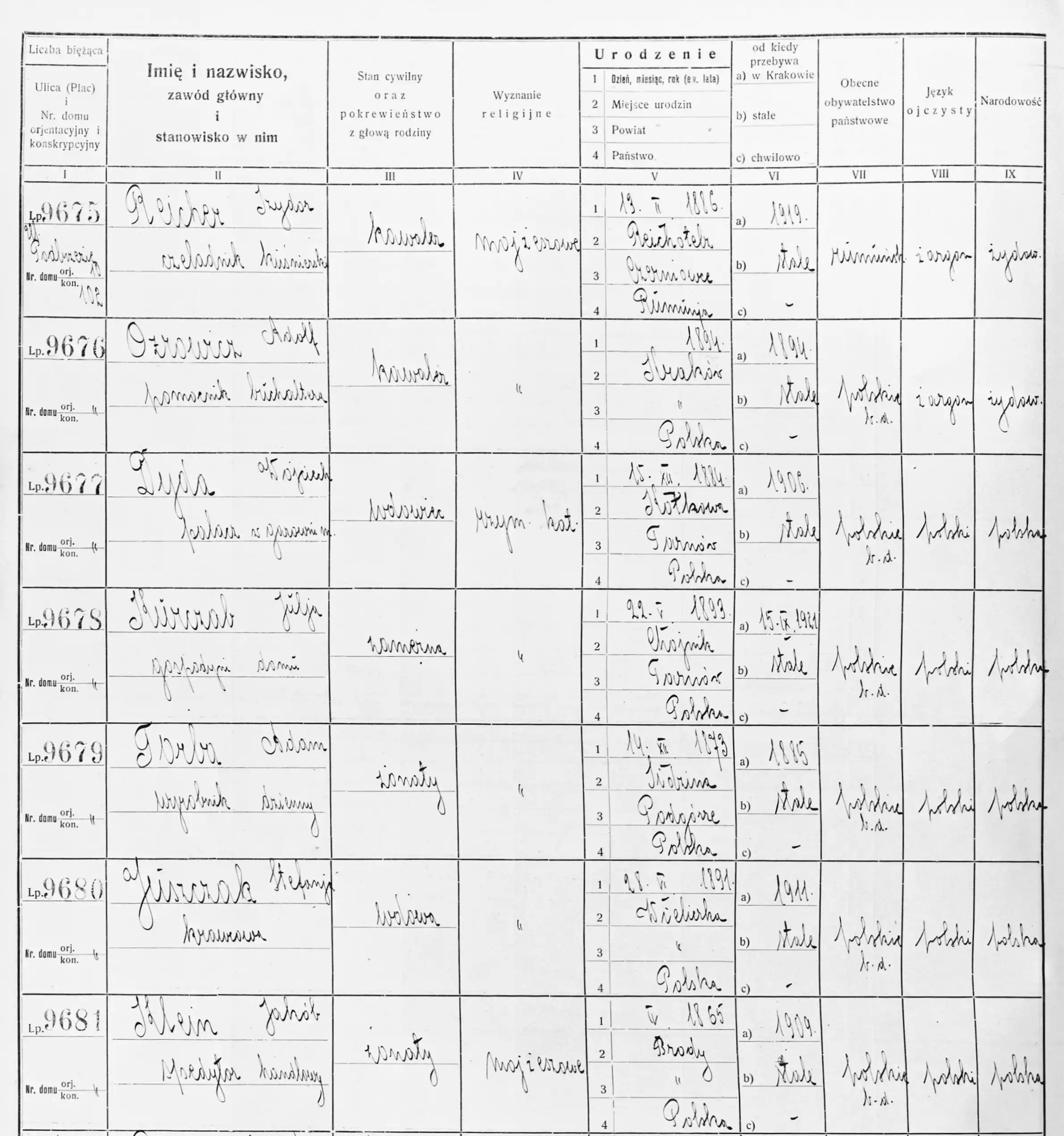
From a genealogist’s point of view, Polish census records can provide a surprising amount of practical information about your ancestors. They were designed to record who lived in each household at the time and often include details that help confirm identity, family links, and place of residence.
Typical information found in Polish census entries includes:
- Full names of all household members - sometimes including extended family, lodgers, or servants.
- Ages and dates of birth - useful for confirming identities or matching other civil and parish records.
- Places of birth and permanent residence - helping to trace where your family originally came from.
- Family relationships - showing how people were related within one household.
- Occupations or professions - giving context about your ancestors’ daily life.
- Addresses and property information - confirming exact locations that can be linked to modern maps.
- Citizenship or nationality - in some records, this helps prove Polish origin for citizenship purposes.
- Marital status and number of children - clarifying family structures across generations.
Even when information is incomplete, a census record can connect generations, prove residency in Polish territory, or fill missing links in your family history. In citizenship cases, these details can support other official records to confirm that an ancestor lived as a Polish national at a specific time.
Need Help Finding Your Ancestors in Polish Census Records? We Can Assist!
Polish national censuses provide a rare glimpse into the past, capturing detailed information about individuals and families at key historical moments. Whether you’re looking to trace family movements, confirm ancestral relationships, or gather evidence for a Polish citizenship application, these records are invaluable. However, finding the right documents in state archives, regional repositories, or online databases can be challenging.
As professional genealogists, we specialise in:
✔️ Locating and accessing census records from different historical periods.
✔️ Deciphering and translating old documents written in Polish, Russian, or German.
✔️ Cross-referencing census data with church records, population registers, and notarial documents.
✔️ Providing detailed research reports that help you understand your family’s history with clarity.
Not sure where to begin?
Send us your question through the contact form and we will point you to the service that fits.
Let’s uncover the missing pieces of your Polish ancestry!
List of Polish Census Years and Available Records
Polish census records were created at different times and under different governments, which means that not all years or regions are equally well preserved.
For family research and citizenship cases, the most useful censuses are those taken after Poland regained independence in 1918 - as they clearly list residents and citizenship status within the new Polish borders.
- 1921 Census - The first full census of independent Poland. It listed every person living in the country after World War I, including names, dates of birth, places of residence, and nationality.
- 1931 Census - The second nationwide census, containing more detailed personal and household data, often used today to confirm citizenship or place of residence before World War II.
- 1946 Census - Conducted after the war, recording the repopulation of Poland and changes in territorial borders. Valuable for confirming post-war residency within Polish territory.
- 1950 Census and later - Post-war censuses compiled by the Polish People’s Republic. These records focused on employment, residence and social data and can still verify permanent residence in Poland during that period.
Earlier population lists and regional censuses from the Austrian, Prussian and Russian partitions may also survive in local archives.
The 1921 Polish Census - A Crucial Record for Citizenship and Genealogy
The 1921 Polish Census is one of the most sought-after records for genealogical research, particularly for those applying for Polish citizenship by descent. As the first full national census conducted after Poland regained independence in 1918, it serves as a vital document proving an ancestor’s official residence and nationality in the newly restored Polish state.
This census recorded names, ages, birthplaces, occupations, religious affiliations, ethnic identities, and places of residence, making it an essential tool for verifying Polish ancestry. For those seeking confirmation of Polish citizenship, it can help establish that an ancestor was living in Poland as a citizen before the major legal and political changes of the 20th century. Additionally, it provides key information for locating other supporting documents, such as pre-war passports, military records, or civil registry entries.
Where to Find Polish Census Records?
Unlike population and residence registers, which were maintained locally, census records were compiled at the national level and are typically held in state archives. Some censuses are fully preserved, while others have gaps due to wars, destruction, or political shifts.
Key sources for Polish census data include:
- State Archives of Poland (Archiwa Państwowe) - The main repository for historical census materials, though access varies depending on the year and region.
- Central Statistical Office of Poland (Główny Urząd Statystyczny, GUS) - Holds official census reports and summaries, though individual household data is often restricted.
- Local archives and libraries - Some census records have been preserved in regional repositories, especially from the interwar period.
- Genealogical databases - Platforms such as Szukajwarchiwach.pl and Genealodzy.pl sometimes include indexed census records, particularly from older collections.
Please note: Having a few accurate details about your ancestor will make searching census records much easier. If you’re not sure of their exact date and place of birth, take a look at the section on our website where we explain Polish birth records.
Using Censuses to Trace Polish Citizenship and Ancestry
For those seeking Polish citizenship by descent, census records can serve as supporting evidence but are not primary proof of nationality. However, they can help:
- Verify continuous residence in Poland before major political changes.
- Identify ancestral birthplaces for locating civil or military records.
- Confirm family relationships needed for citizenship applications.
Because Polish citizenship laws rely on direct lineage rather than place of birth alone, census records are best used to guide further document searches rather than as sole proof of ancestry.