Polish People Around the World: Diaspora and Statistics
Polish people around the world include recent migrants, families established abroad for generations and communities whose history reflects changing borders. The GUS and Ministry of Foreign Affairs Atlas of Polonia and Poles Abroad estimates more than 22.1 million people in 138 countries. Its population figures refer to May 2025 and include descendants as well as Polish citizens.
The United States, Brazil and Germany have the largest communities in that overview, and Britain comes fourth. In each of them, many families have records that lead back to a particular Polish town or parish.
How many Polish people live around the world?
The figure of over 22.1 million counts the Polish diaspora outside Poland only. It comes from the Atlas produced by Statistics Poland (GUS) with the Polish Ministry of Foreign Affairs, whose methodology is published alongside the data.
The estimate was put together from diplomatic and consular reports based on national statistics or local estimates. Where figures differed, the Atlas took the highest value, so it is a broad community estimate, not a count of Polish passport holders.
Older summaries often give about 20 million. There is no worldwide census that asks the same question about Polish ancestry, so totals from different sources and years are not directly comparable.
Polish diaspora and Polonia: what do the terms mean?
Polish diaspora is a broad term for people with Polish connections living outside Poland. Polonia is commonly used for communities of Polish origin abroad. Someone born in Manchester with Polish grandparents may identify with Polonia despite never having lived in Poland. A person who recently moved from Warsaw has a different migration history, although both may belong to the same local community.
Statistics on Polish communities abroad use four different measures:
- Country of birth: where a resident was born.
- Citizenship or nationality: their legal relationship with a state, subject to the source’s definition.
- Reported ancestry or origin: the background they describe in a survey or census.
- Diaspora estimate: a wider assessment of a community, potentially including several generations.
A person can fit several categories at once. A British-born descendant will not appear in a count of residents born in Poland, and a Polish-born person may have taken another citizenship.
Which countries have the largest Polish communities?
The Atlas overview names six particularly large communities. The rounded estimates include people of Polish origin as well as citizens.
| Country | Estimated community | Reference period |
|---|---|---|
| United States | 10 million | May 2025 |
| Brazil | 3 million | May 2025 |
| Germany | 2.2 million | May 2025 |
| United Kingdom | 1.3 million | May 2025 |
| France | 1 million | May 2025 |
| Canada | 1 million | May 2025 |
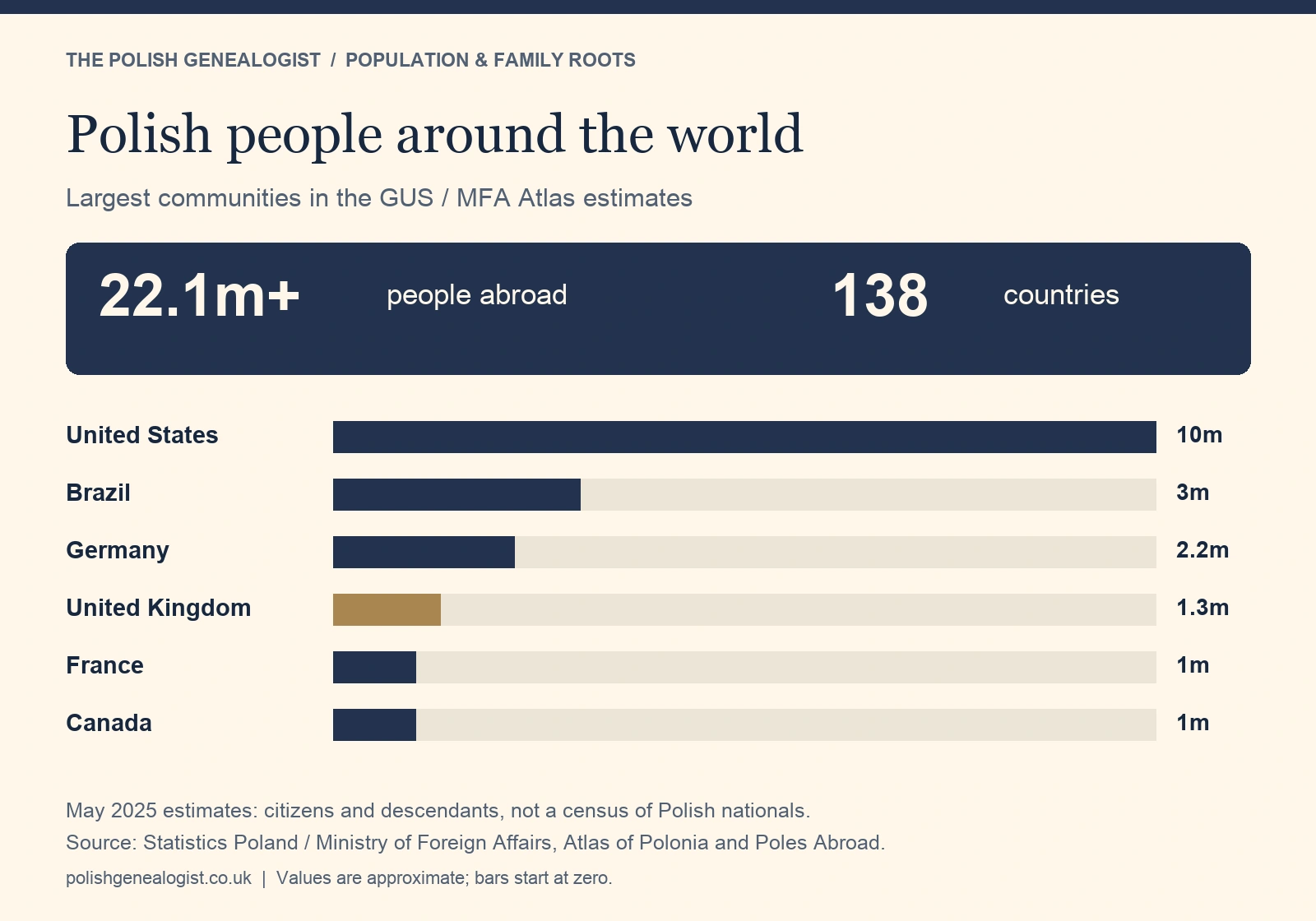
Half of the six largest communities, in the United States, Brazil and Canada, are in the Americas.
Polish population statistics: what national censuses count
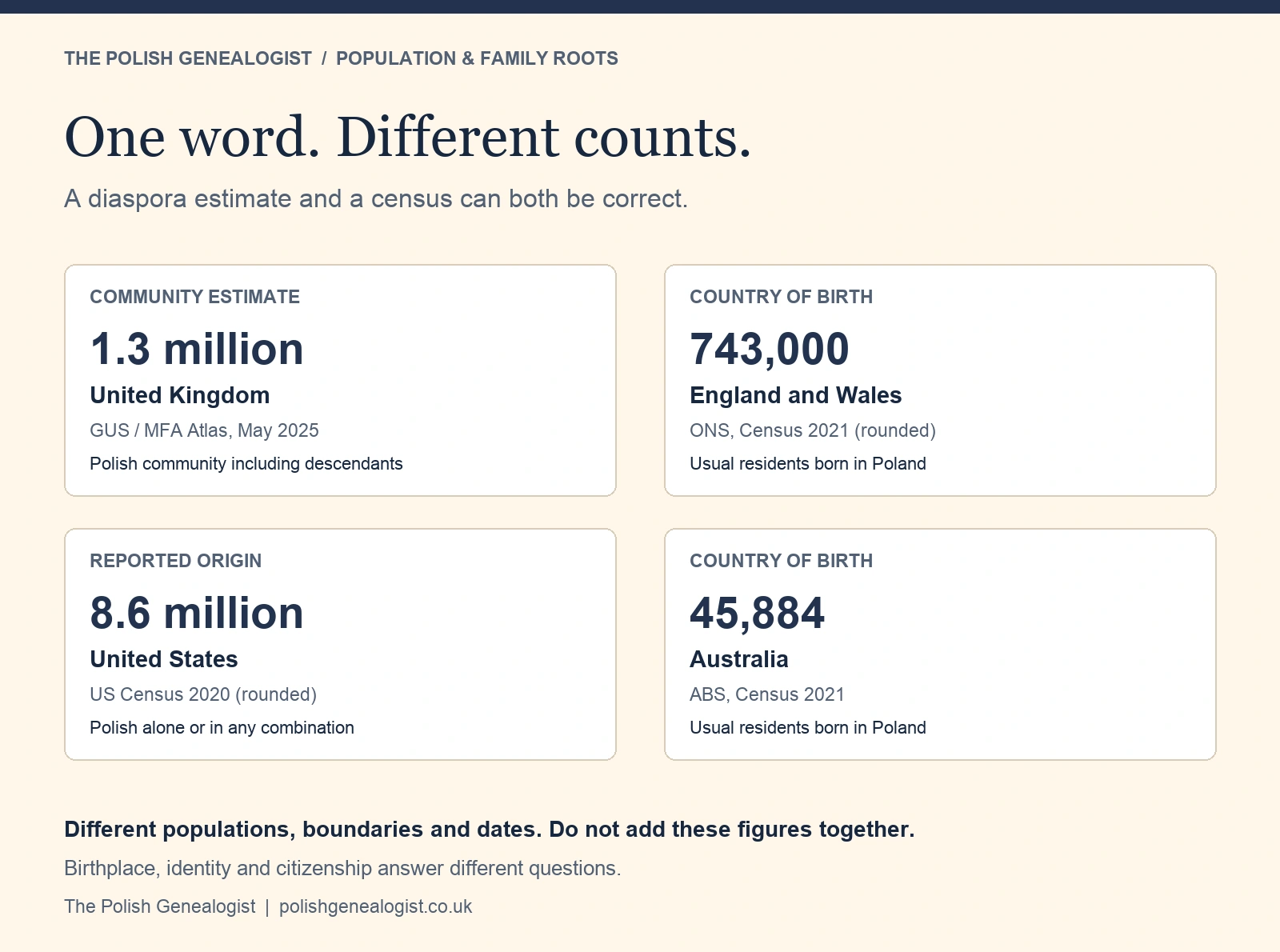
National censuses give a narrower view, because they count birthplace or reported origin. The figures below come from the 2020 and 2021 censuses.
Polish people in America
The US Census Bureau’s analysis of the 2020 Census reports approximately 8.6 million people in the Polish group, alone or in any combination. This counts reported origin, not birth in Poland or Polish citizenship.
Australia and England and Wales
The Australian Bureau of Statistics counted 45,884 usual residents born in Poland in its 2021 country-of-birth QuickStats. Australian-born children and grandchildren of Polish migrants are outside that birthplace group.
For England and Wales, the Office for National Statistics reports approximately 743,000 residents born in Poland in Census 2021. The figure leaves out Scotland, Northern Ireland and British-born descendants.
Why did Polish families settle abroad?
Different migrations produced different records. The Library of Congress’s Polish and Russian immigration material describes people seeking stability and building communities in American cities and agricultural areas. It also explains the complexity of migration from the Russian Empire, which involved Poles, Russians and Jewish communities among others.
For emigrants before 1918, a record naming Russia, Germany or Austria as the country of birth often refers to a town in the partitioned Polish lands. The town named in the document, not the country label, is what leads to the Polish registers.
War and displacement created other routes. The National Archives’ documents about Polish refugees in South Asia show Polish refugee families passing through several countries before they settled permanently.
Later migration was driven by work, study and family reunification, especially after Poland joined the European Union on 1 May 2004, as confirmed in the UK Parliament’s accession notes.
Polish people in Britain: the connection to family history
Britain’s Polish community includes families of wartime servicemen, post-war resettlement and later migration. The National Archives’ Polish resettlement scheme document, dated 7 March 1947, sets out the accommodation arrangements for soldiers and their dependants.
Certificates, naturalisation papers, photographs, addresses and letters kept by the family often name a camp, unit or birthplace. Our Polish Resettlement Corps research guide explains these records.
Population figures for Britain are in the separate Polish population in the UK guide.
How to trace Polish ancestry from another country
Our Polish family history research service follows a documented family line into Polish civil, parish and archival records. We check names, places and dates, test possible matches and explain the findings in English, with source references and copies where available.
Send us the names, approximate dates and any documents you have, and choose a research package for the family line you want investigated. We read the certificates, immigration, naturalisation and military papers for clues, work out the spelling variants and the correct locality (including towns with similar names), check identities using parents, spouses, occupations and addresses, and then search the surviving Polish civil, parish and archival records.
Records from the country where a family settled can help establish its connection to Poland. Australia’s national archives, for example, hold migration, naturalisation and passenger material. In Britain, our naturalisation records guide explains the clues that British evidence can supply.
Illustrative example (not a client case): an ancestor born in 1888 appears under two spellings of his surname, and a family letter names a village. We would compare the village with his immigration and marriage documents, then test a Polish birth entry against his parents’ names before accepting it as his.
Our report separates confirmed relationships from possible matches. The research covers the agreed family line and scope; we cannot guarantee that every record has survived.
Official sources
Sources checked on 7 October 2026. Dates beside statistics are the reference dates of the data.
- GUS and MFA Atlas of Polonia and Poles Abroad and its metadata: community estimates and definitions.
- Powroty government overview: Atlas totals and largest communities.
- US Census Bureau: 2020 detailed population-group analysis.
- Australian Bureau of Statistics: Poland-born residents in 2021.
- Office for National Statistics: England and Wales, Census 2021.
- Library of Congress: Polish and Russian immigration history.
- The National Archives: refugee routes; resettlement document.
- National Archives of Australia: family and migration research.
- UK Parliament: EU accession notes.