Polish Birth Records: How to Find, Read and Request Official Copies

Polish birth records can connect a name or birthplace in your British family papers with earlier generations in Poland. An original birth or baptism entry may reveal parents, an address, witnesses and family connections. Our family-history research follows these clues through Polish archival sources and explains the discoveries in English. This guide shows what the records can reveal, how online indexes relate to the originals and which kind of copy suits your research.
What are you hoping to find?
Professional record service
Request a Polish birth record from the UK
Find an archival image
We locate the relevant birth or baptism entry and obtain an available scan or ordinary copy.
Targeted record searchesObtain an official copy
Tell us the requirements for your procedure in Britain or abroad. We identify the holding institution and the appropriate available document, with English-speaking support.
Copy orders or a quote, according to the requestPolish birth records - what they are and why they matter
A Polish birth record is the register entry made when a child was born or, in many periods, baptised, in present-day Poland or the lands of the former Polish-Lithuanian Commonwealth.
What counts as a “Polish birth record”?
Depending on the historical period, region, and administrative system in place, a “Polish birth record” may refer to:
- A civil register entry (akt urodzenia) - created by a local civil registrar or, in earlier periods, by a parish priest acting as registrar. Civil registration began in 1808 in the Duchy of Warsaw and on 1 October 1874 in Prussia; in Galicia the parish books served as the official registers until civil registry offices were set up after the Second World War.
- A church record (metryka chrztu / baptismal record) - maintained by Roman Catholic, Orthodox, Lutheran, or other parish churches. Before civil registration existed, and sometimes alongside it, church records were the primary source of birth information.
- Jewish metrical books (księgi metrykalne) - records kept by Jewish communities, often in Hebrew, Yiddish, Polish, Russian, or German depending on the period and location. Many survive in Polish state archives.
- Records from other religious communities - including Greek Catholic, Evangelical, Mennonite, and others, each with their own record-keeping traditions.
Official and reference sites mentioned in this guide:
- Polish State Archives (official website) → https://archiwa.gov.pl/en/
- Search in the Polish State Archives (Szukaj w Archiwach) → https://www.szukajwarchiwach.gov.pl/
- FamilySearch → https://www.familysearch.org/
Why records differ by region
From 1795 to 1918 Polish territory was divided between Russia, Prussia and Austria, and each kept its records in its own way:
Russian (Congress Poland)
- Languages you may encounter
- Polish, Russian, Latin
- Record format
- Narrative paragraphs, later tabular forms
Prussian (Greater Poland, Pomerania, Silesia)
- Languages you may encounter
- German, Latin, Polish
- Record format
- German-style civil registers, often tabular
Austrian (Galicia)
- Languages you may encounter
- Latin, Polish, German
- Record format
- Church books with Latin entries, later Polish civil acts
A birth in Kalisz, one in Poznań and one in Kraków in the same year can look entirely different. Reading them means knowing the administration that produced them as well as the language.
Birth record vs birth certificate (official copy): which one do you need?
In everyday English, people often use “birth record” and “birth certificate” interchangeably. They are different things:
- If your goal is genealogy: you often need the original entry (scan/photo) or at least an image of the register page so you can confirm details beyond the index.
- If your goal is legal/official use: you typically need an official document issued or certified by the relevant authority (requirements vary by institution and country, so always check the receiving office’s rules).
Quick decision guide
The institution receiving the document sets the final requirements:
| Your goal | Usually enough | Often required |
|---|---|---|
| Family tree / ancestry research | scan or photographed entry; reliable index + scan | translation if the record is not in English |
| Polish citizenship by descent / legal confirmation | evidence chain across generations | official extract/certified copy + acceptable translation |
| Marriage file / administrative procedures | depends on jurisdiction | official certificate/extract issued for official use |
A birth entry is usually checked against other records: a marriage entry names parents and places, and a death entry gives an age and family details to compare. For a formal application, our guide to Polish citizenship for British citizens explains how the documents must connect across generations.
Four Polish birth documents: discover the family behind the names
A birth document can open several paths into a family’s history. The examples below show a full civil copy, a short civil copy, a parish certificate and an extract from a Jewish registration district. Each records a birth, but the details included and the date the copy was issued differ. For a family researching from Britain, a surviving certificate can give us the names and locality needed to follow the earlier Polish records.
A full birth-record copy: parents and their places of origin
01 / Full civil copy / Krakow
One birth, two routes into an earlier generation
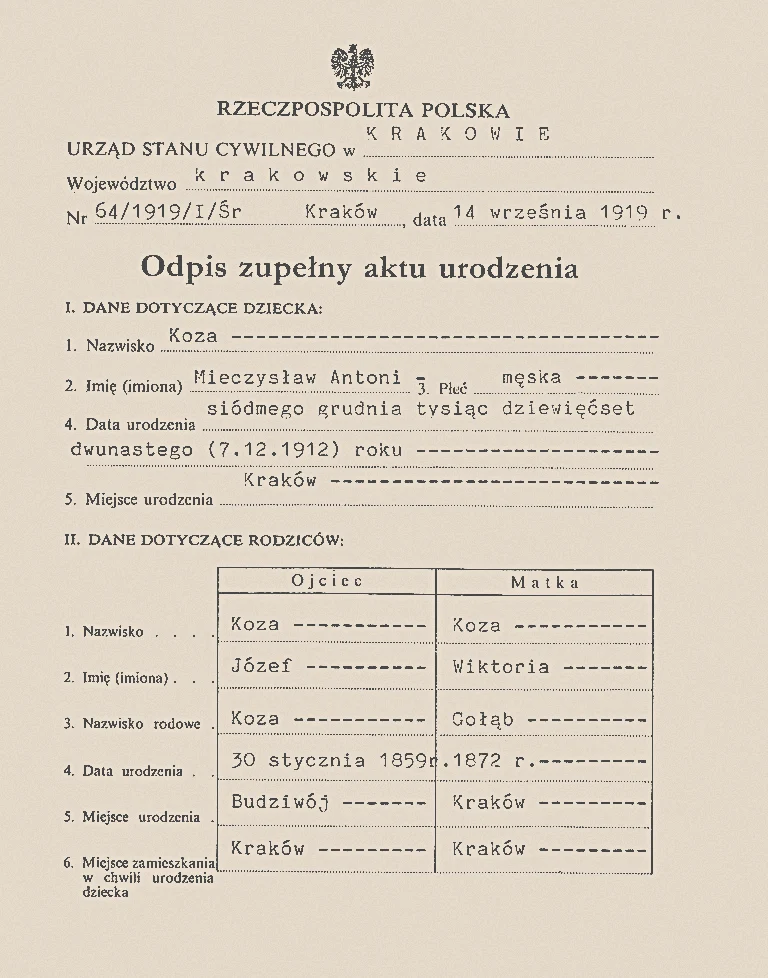
This odpis zupełny aktu urodzenia records Mieczysław Antoni Koza’s birth and adds details about both parents. Their own birthplaces turn a Krakow family document into a starting point for research in more than one locality.
What this document reveals
- The child’s identity
- The entry gives the surname Koza, the names Mieczysław Antoni, male sex and a birth in Krakow on 7 December 1912. These details can be compared with a British certificate, service record or family paper.
- The father’s birthplace
- Józef Koza is recorded as born on 30 January 1859 in Budziwój. This points the investigation towards his own birth or baptism entry and the generation before him.
- The mother’s maiden name
- The document records the mother as Wiktorja Koza, with the maiden surname Gołąb, a birth year of 1872 and birthplace Krakow. The maiden surname gives us a second family line to identify; the spelling Wiktorja is retained from this copy.
- Where the parents lived
- Both parents’ residence is given as Krakow at the time of the birth. Reading birthplace and residence separately helps connect the father’s earlier home with the family’s later life in the city.
Discover grandparents through the parents
The father’s precise birth date and locality give a focused search for his parents. The mother’s maiden surname and birth year provide a separate route into the Krakow records.
Connect the family across places
A parental marriage record and local residence records may bring these two routes together. We compare the names, ages and places before linking the generations.
A short birth-record copy: the clues in a compact certificate
02 / Short civil copy / Dębica
A later certificate can lead back to an earlier entry
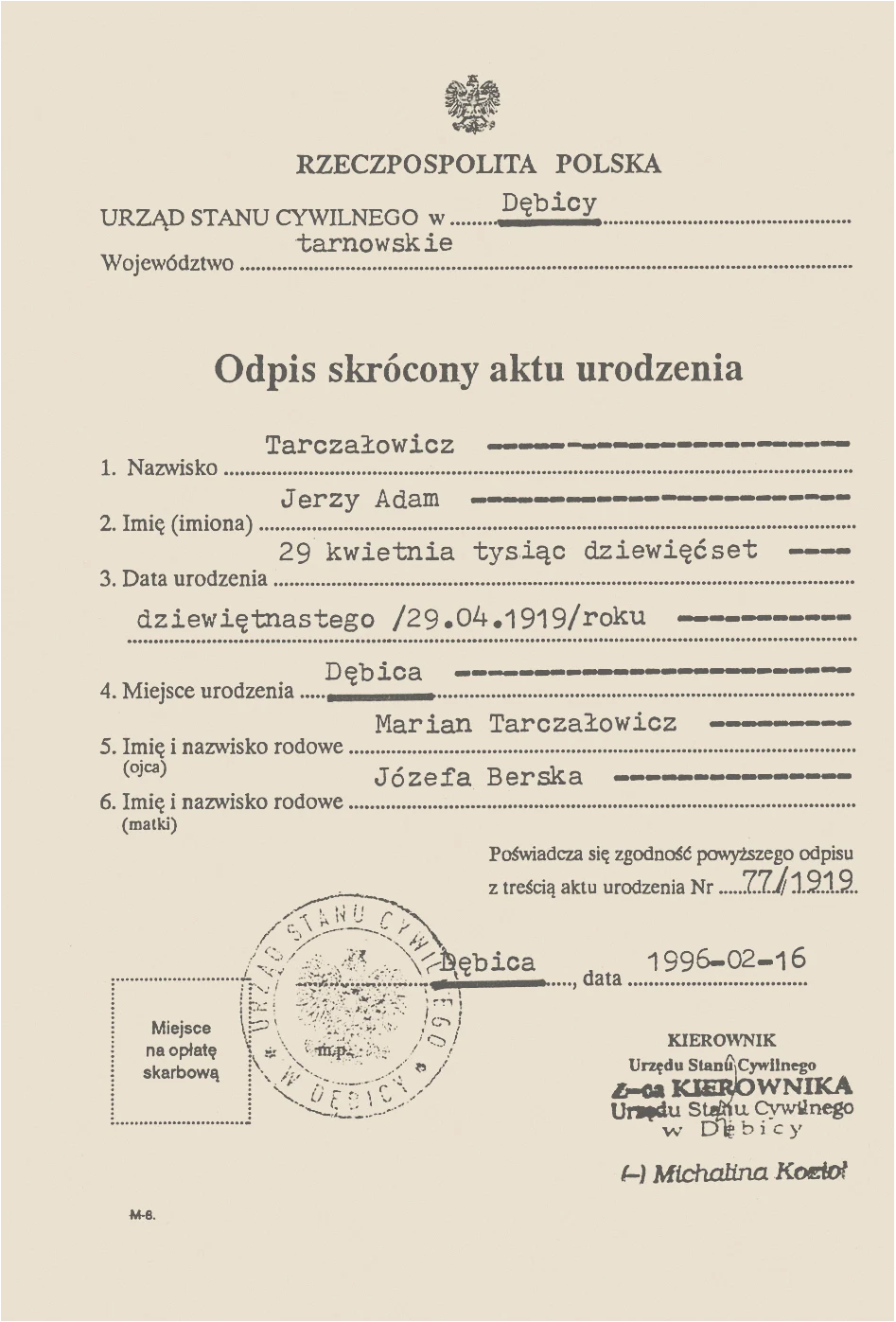
This odpis skrócony aktu urodzenia was issued in 1996 for a birth in 1919. It brings the child’s identity and parents together on one page, offering a clear starting point for locating the underlying entry.
What this document reveals
- Name, date and place
- The child is Jerzy Adam Tarczałowicz, born on 29 April 1919 in Dębica. The date is written both in words and numerals, helping confirm the reading.
- The parents’ names
- The father is Marian Tarczałowicz; the mother is Józefa Berska. Her maiden surname is a useful clue for a parental marriage search and her own birth record.
- Birth date and issue date
- The registrar certified this copy on 16 February 1996. The family event belongs to 1919: an issue date tells us when a document was obtained, rather than when the child was born.
- Following the underlying record
- The copy names the issuing office and identifies the birth entry. We use those details to locate the appropriate source and investigate what further family information is available.
Recognise the person in British papers
The two forenames, precise birthday and locality help compare this certificate with later British records, including documents using spellings without Polish accents.
Choose the copy that answers your question
For ancestry, the underlying birth entry may add useful detail. For an official procedure, we establish the required document format with the receiving authority before arranging the copy.
How to find Polish birth records for your family
A focused Polish birth-record search combines identity details, the historical locality and the right register. These steps explain how we turn a family clue into a targeted investigation.
Step 1: Collect the minimum information
Aim for:
- full name (including possible spelling variants),
- approximate year (even “±5 years” helps),
- place: town/village and, ideally, the parish,
- parents’ names (if known).
If the birthplace is uncertain, a British certificate, naturalisation paper or military file may supply a more precise locality. Our guide to identifying the Polish village and parish explains how place-name clues guide the next search.
Step 2: Compare online indexes with original Polish birth records
Online indexes cover many digitised older registers, but they contain errors. We check every index result against the original scan.
Step 3: Identify what you actually found
When you find a result, ask:
- Is it an index entry only, or do you have an image/scan?
- Does it show parents’ names and the right locality?
- Are there multiple candidates with the same name?
Step 4: Request the record where it is held
If you know the place and approximate year but there’s no digitised access, the next step is usually a targeted enquiry to:
- the relevant archive (for older material), or
- the relevant civil registry office (for more recent material),
or an alternative source such as church/community registers.
Polish birth records online: indexes, scans and archival searches
Only part of the Polish registers can be searched online:
- Some Polish records are digitised and searchable online.
- Many are not digitised, not indexed, or only partially indexed.
- Free to view may still mean registering on the site, and a scan is not an official copy for legal use.
What free access covers
Usually one of these:
- free access to indexes (names + basic event details),
- free access to scans/images where the archive has published them,
- free access with limitations (search is free, full images require login or have restrictions).
Index vs scan vs official copy (don’t mix them up)
- Index: great for discovery; can be wrong or incomplete.
- Scan/photo of entry: best for genealogical proof and extracting full details.
- Official copy/certified extract: needed for many legal procedures; must come from the proper authority and in the correct form.
How to verify you found the right person
Check three points:
- parents’ names (including mother’s maiden name when present),
- the exact locality (town/parish),
- year consistency (birth year vs later documents such as marriage/death).
If only one matches, treat the result as a lead, not proof.
Who holds the record? Decision tree by year (USC vs archives vs church)
Before any request, find out which institution holds the register.
Under Polish law, a civil registry office keeps birth registers for 100 years and marriage and death registers for 80 years, then passes them to the state archives. Transfers do not always happen on time, so the holder has to be checked for each locality.
If the birth is relatively recent
Recent civil birth records are typically held by the local Civil Registry Office (Urząd Stanu Cywilnego, USC) responsible for the place of birth. Access is limited to entitled persons, such as the person named and close relatives.
What to do:
- identify the correct USC for the locality,
- prepare the person’s details (name, date, parents, place),
- check what form of copy you need (for official use vs informational).
If the birth is older (historical)
Older registers are often transferred to State Archives (Archiwa Państwowe) or remain in other repositories depending on the type of register and local history. Many archives also hold church registers or copies.
What to do:
- identify the archive relevant to the historical administrative unit,
- check whether scans exist online,
- if not, plan an archive enquiry or request for a copy (format and availability depend on the archive and the material).
If civil registration didn’t apply (or the record is missing): church/community registers
In some periods and locations, the usual substitute is a baptismal or community record:
- Roman Catholic, Orthodox, Lutheran parish registers,
- Jewish metrical books (often preserved in archives; language and structure vary).
They are strong genealogical evidence. Whether an authority accepts them for a legal procedure, and in what form, is for that authority to decide.

Polish birth records in the 1800s and 1920s - what changes
The period and historical locality affect the register format, language and institution holding it. For a family tracing an ancestor born in the 1800s or 1920s, those details help us select the right Polish birth or baptism records.
1800s: more language variation and narrative formats
In the 19th century, you may encounter:
- narrative paragraph entries,
- varying scripts and handwriting,
- records written in Polish, Latin, German, or Russian depending on the region and time period.
Reading them means deciphering the handwriting and identifying historical place names.
1920s: more standardisation (but not “fully online”)
In the interwar period, records can be more standardised, but availability online still depends on:
- digitisation status,
- repository,
- access rules.
A birth from the late 1920s may still be held by the civil registry office, because birth registers stay there for 100 years. It then needs a formal request rather than an online download.
How to read Polish birth records (Polish, Latin, German, Russian)
Reading Polish birth records means extracting the identity and family details from the original entry, then checking how they connect with the person in your family papers. The language and register format guide the reading.
1) Identify the language quickly
A few words or the script usually tell you:
- Look for repeated words like “born”, “year”, “father”, “mother”, “witnesses”.
- Recognise scripts:
- Cyrillic suggests Russian records.
- Gothic handwriting may appear in German-language records.
If the language or handwriting is unclear, do not guess. Misread names are a common cause of wrongly linked families.
2) Extract the key facts (in this order)
Note each of these:
- Record number / entry number
- Date of the record (sometimes different from the birth date)
- Birth date and place
- Child’s given name(s) and surname
- Father: name, age, occupation/status, residence
- Mother: name + maiden surname (if present), residence
- Witnesses/godparents (often relatives)
- Notes in margins (later legitimisation, recognition, corrections)
3) Common Polish terms (mini glossary)
Terms common in Polish-language entries:
| Polish term | English meaning |
|---|---|
| Akt urodzenia | Birth record / birth certificate |
| Metryka urodzenia / chrztu | Birth or baptism record |
| Urodzony / Urodzona | Born (male / female) |
| Dnia… roku… | On the day of… in the year… |
| Miejscowość / Wieś / Miasto | Place / village / town |
| Parafia | Parish |
| Rodzice | Parents |
| Ojciec / Matka | Father / Mother |
| Imię / Imiona | Name / Names |
| Nazwisko | Surname |
| Dziecko / Syn / Córka | Child / Son / Daughter |
| Świadkowie | Witnesses |
| Chrzest / Ochrzczony / Ochrzczona | Baptism / Baptised |
| Ksiądz / Proboszcz | Priest / Parish priest |
| Zawód / Stan / Pozycja | Occupation / status |
| Miejsce zamieszkania | Place of residence |
| Data urodzenia / chrztu | Date of birth / baptism |
| Nr aktu / Numer kolejny | Record number / entry number |
Common reading mistakes
- Treating an index transcription as the record (always verify with an image when possible).
- Assuming modern place names and borders (names and jurisdictions changed).
- Forcing an English spelling of a surname (keep the original spelling and track variants).
- Ignoring witnesses/godparents (they can confirm family connections).
A parish birth certificate: a village and the next family connection
03 / Parish certificate / Końskie
A small place name can lead to the next search
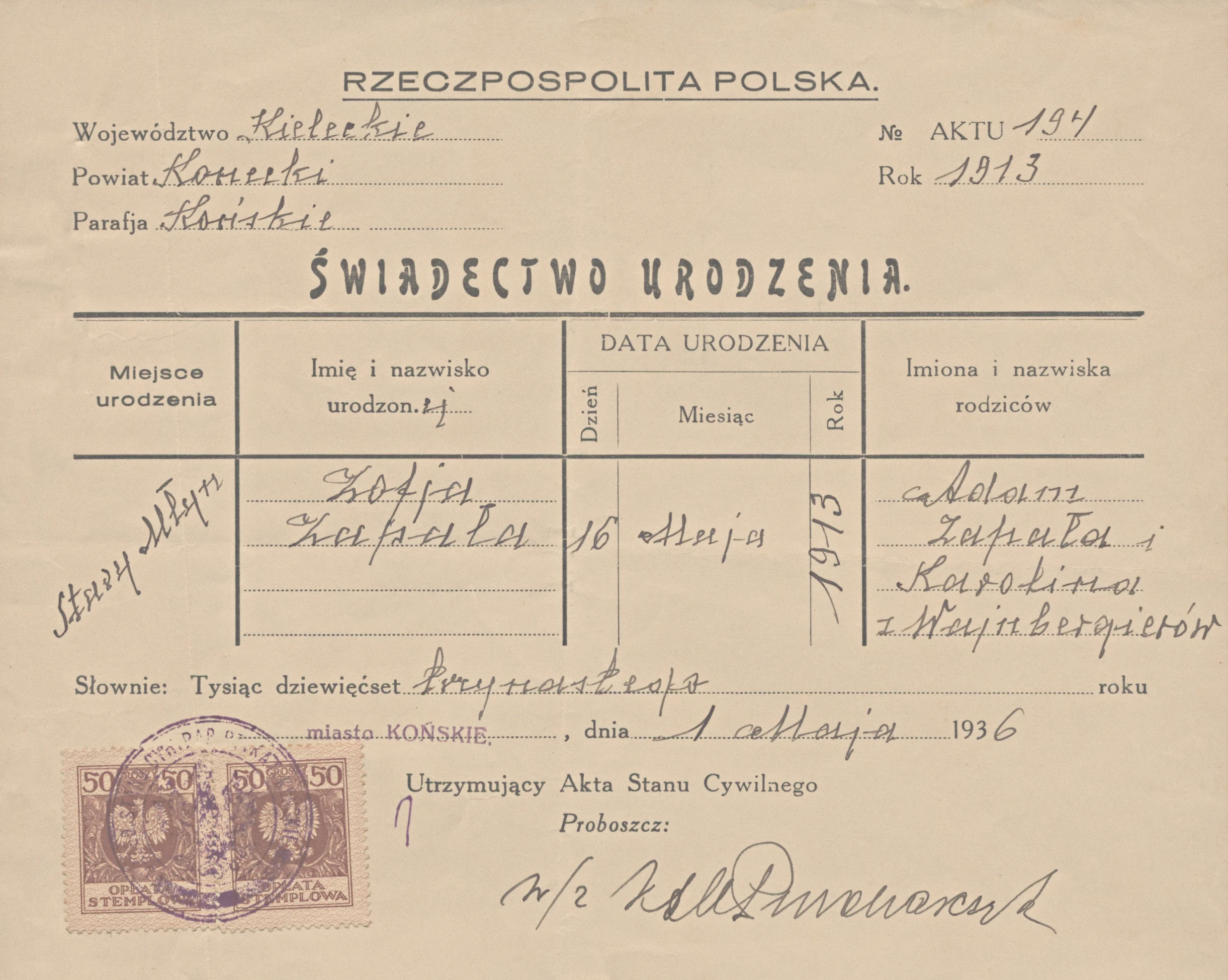
This świadectwo urodzenia records a birth in 1913 and was issued in Końskie in 1936. Its headings bring together the village, parents and parish context needed to investigate earlier family events.
What this document reveals
- The child and birthplace
- The name reads Zofia Zapała. The birthplace is written as Stary Młyn. Identifying the correct locality within the parish is a useful step towards finding the family’s original register entries.
- A handwritten birth date
- The date fields give 16 August 1913, with sierp. as the abbreviated month. Reading the column headings helps distinguish the birthday from the certification date at the bottom.
- The earlier generation
- The parents are named Adam Zapała and Karolina, followed by the mother’s maiden-family wording. We compare less clear handwriting with other family entries before fixing a surname spelling in a research report.
- The parish and certification
- The header identifies Końskie parish; the certificate was issued on 1 October 1936. The words Utrzymujący Akta Stanu Cywilnego and Proboszcz identify the parish priest’s role on this document.
Find the family’s parish records
The village, parish and parents give us a focused route to birth, baptism and marriage material. Related entries can help clarify the mother’s maiden name and identify siblings.
Bring local detail into the family story
A small settlement name often adds more precision than the nearest town remembered abroad. We place the locality in its historical setting and explain the connections in English.
A Jewish birth-record extract: names and a maternal family line
04 / Jewish registration district / Końskie
Trace a family through its community records
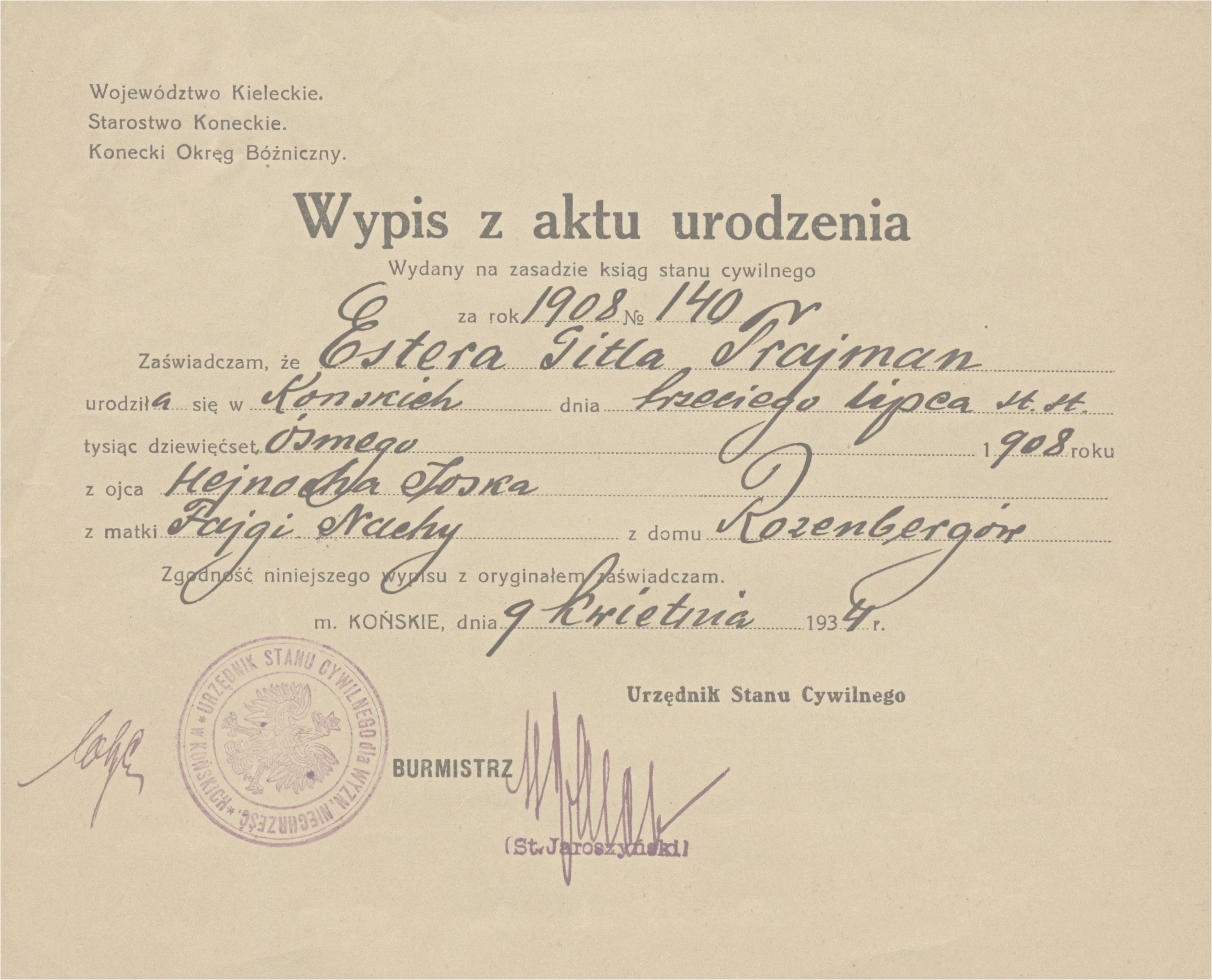
This wypis z aktu urodzenia comes from the Końskie Jewish registration district. The child’s names, birth date and maternal maiden-family wording create several useful connections for Jewish family research.
What this document reveals
- The recorded identity
- The child’s name reads Estera Gita Trajman, born in Końskie on 3 July 1908. Both forenames can help compare records where only one was used later.
- Names linking generations
- The form names both parents and records the mother as Fajga Necha, followed by z domu Rozenbergów. This points to the Rozenberg family; the ending is part of the Polish wording rather than automatically a surname spelling to carry into every record.
- Community and locality
- The header identifies the Końskie Jewish registration district. That context helps select the appropriate metrical collection for the family and period.
- The extract and the earlier birth
- The document refers to the civil-status books for 1908 and certifies the extract on 9 April 1934. The earlier entry is the next source to investigate for additional family detail and comparison of handwriting.
Follow the maternal surname
The maiden-family wording gives a route towards the parents’ marriage and the mother’s earlier records. Comparing related entries can clarify name variants and connect another generation.
Connect records across languages
Jewish family research may involve different languages and spellings over time. We compare names alongside dates, relatives and places to connect the Polish evidence with papers preserved by descendants in Britain.
From British family papers to Polish birth and baptism records
A British marriage certificate, naturalisation file or service record may name an ancestor born in Poland. The place can appear in an older language or spelling, and the recorded age may be approximate. We compare the British clue with the historical locality and the family’s names before choosing the Polish register to investigate.
A Polish baptism record can contribute birth and parentage information alongside the baptism itself. We keep those dates separate and compare parents, witnesses, addresses and later annotations with other records. The investigation can then follow the same family into marriage, sibling and residence evidence within the agreed research scope.
Researching Polish birth records from Britain
A Polish record can be requested from Britain. How it is done depends on:
- whether the record is held by a civil registry office or an archive,
- access restrictions and eligibility,
- the form of copy required,
- payment and delivery logistics.
For clients outside Poland, our record search covers these steps:
- identifying the correct repository,
- writing to it in Polish,
- following up and arranging delivery,
- explaining the entry in English, whether it is written in Polish, German, Latin or Russian.
Using Polish birth records for citizenship and legal purposes (checklist)
For citizenship confirmation, marriage or another legal procedure, check the following.
Before you request anything, confirm:
- What exact document type is accepted by the receiving institution (certificate/extract vs certified copy vs scan).
- Whether an official translation is required and in what form.
- Whether you need additional records to connect generations (marriage/death).
When you have the record, verify:
- names and surnames (including maiden names),
- dates and places (consistency across documents),
- any marginal notes that may affect identity,
- whether the copy is suitable for official use (format and authentication requirements vary).
Ask the receiving office for its requirements in writing.
Following the next clue in a Polish birth-record search
When a birth entry cannot be found, the cause is usually one of these:
- Wrong place/parish
Try neighbouring parishes, older jurisdictions, and historical maps/gazetteers. - Name variants
Search with spelling variations, simplified forms, and phonetic equivalents. - The record exists but isn’t online
Many registers are not online. The record then has to be requested from the archive or office that holds it. - Index errors
If an index gives you a clue, confirm with the scan or request the original entry. - Multiple people with the same name
Use parents, residence, and witnesses/godparents to disambiguate.