Tracing Polish Military Service: A Guide for UK Families
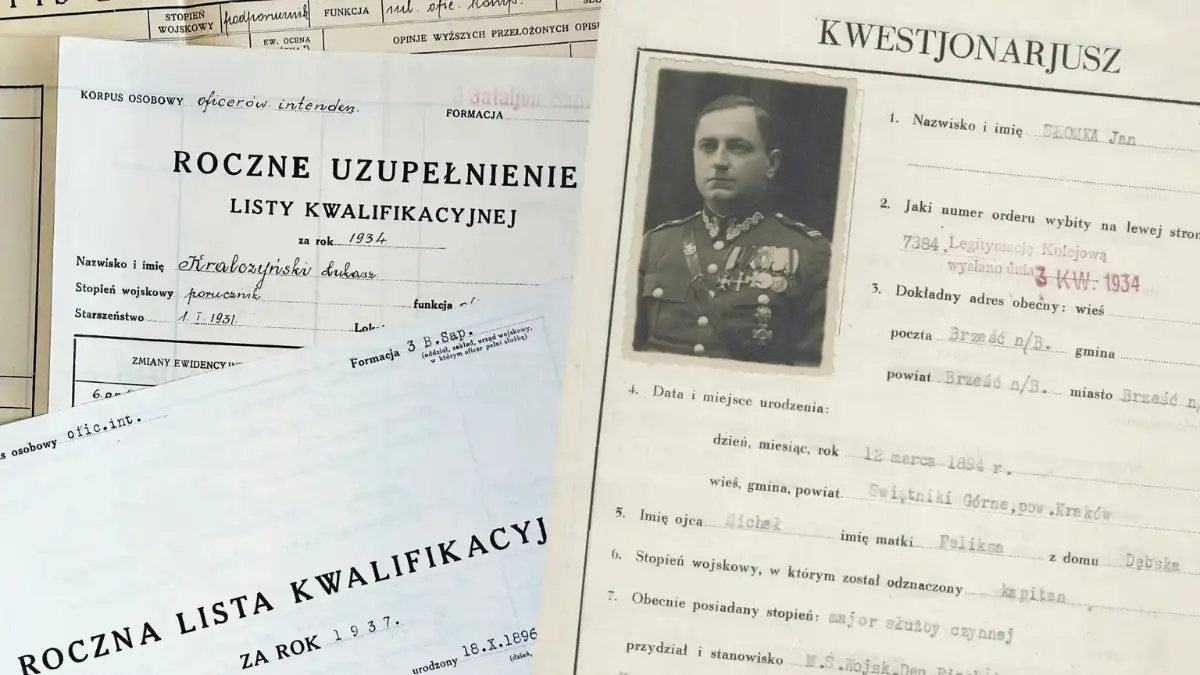
For a family in Britain, an old Polish service book, a UK address or a relative’s wartime photograph can be the first clue to a much wider story. This guide helps you connect those clues with Polish military records and identify which stage of the research belongs in the UK, Poland or another archive.
Begin with the person’s identity and service timeline. A UK-held personnel file, a Polish pre-war record and a prisoner-of-war document answer different questions; treating them as separate pieces of evidence helps you choose a focused search instead of sending the same request to every institution.
What are Polish military records?
In genealogical research, Polish military records may include:
- Conscription and draft records (eligibility, residence, occupation, physical description)
- Service records / personnel files (units served, ranks, postings, promotions, discharge)
- Casualty records (wounded, killed, missing, captured)
- Prisoner of War (POW) records (camp lists, index cards, liberation notes)
- Pension and veterans’ records (health impact, dependants, post-service circumstances)
- Decorations and medals (award registers, citations, questionnaires)
- Military identity cards and wartime documents (often the fastest way to identify the right archive)
Even if a complete personnel file does not survive, it is often possible to reconstruct service history by combining smaller pieces of evidence from multiple sources.
Before you start: what information helps most
If you want results (or you plan to ask an archive or researcher for help), try to collect:
- Full name (including spelling variants and Anglicised forms)
- Date of birth and place of birth (village/town matters)
- Parents’ names (very useful with common surnames)
- Approximate service period (for example: WW2, pre‑1939, WW1)
- Any unit or branch clues (Army / Air Force / Navy; regiment/division/squadron)
- Any numbers (service number, POW number, medal number)
- Post‑war country (UK/US/Canada/Australia, etc.)
If you’re not sure of your ancestor’s exact date or place of birth, we invite you to take a look at the section on our website where we explain Polish birth records.
Where to look for Polish military records (choose the most likely scenario)
Polish Army records from the Second World War
A Polish serviceman’s Second World War history may span the September 1939 campaign, service in exile, captivity and resettlement in Britain. Start with the unit and dates you know: records may be held in both Polish and British collections, with different institutions documenting different stages of the same person’s life.
Common starting points include:
- Polish Institute and Sikorski Museum (PISM), London
Particularly relevant for Polish forces connected with the Western Allies and Polish forces in exile.
https://pism.org.uk - The National Archives (UK) – Discovery catalogue
Useful for locating UK-held references and record series connected to wartime administration and military context.
https://discovery.nationalarchives.gov.uk - FamilySearch (Poland research guidance)
Helpful for understanding Polish jurisdictions, archival structures, and where to search next.
https://www.familysearch.org - EHRI Portal (cross‑archive wartime discovery)
Valuable when persecution, imprisonment, forced labour, camps, or displacement may be part of the story.
https://portal.ehri-project.eu
What to expect: WW2 research is rarely solved with one database search. The most productive approach is to confirm identity and service context first, then target the most likely record holder.
Anders’ Army / Polish II Corps: Many people specifically look for an Anders Army soldiers list or Polish 2nd Corps military records. These are often best handled as part of a broader WW2 service-route search, because the same person may appear across multiple record types and institutions.
Finding Polish military records in the UK
For a relative who served with Polish forces under British command, begin with the UK service-record application route. GOV.UK explicitly includes Polish personnel who served with the British during the Second World War. Check its current application guidance before sending documents.
The British Army lists APC Disclosures 5 (Polish), RAF Northolt for enquiries about Polish forces under British command. Confirm the current address and instructions on the Army Personnel Centre page. A service number is helpful; also gather the full name, birth details and any evidence of death. Our guide to UK MOD Polish service records explains how this route fits into family research.
Polish Resettlement Corps records (UK)
Some families discover a UK paper trail through Polish Resettlement Corps records. You may also see references to a Polish Resettlement Corps list, sometimes circulated as a PDF. Coverage and availability vary, but these records can provide valuable post‑war identity and residence clues when your family story includes settlement in Britain.
More detail: UK MOD Service Records
Polish Air Force records from the Second World War
If you suspect aviation service—often hinted by photographs, insignia, logbooks, or family stories—treat this as a specialist research track. Polish Air Force records from the Second World War may be supported by unit references, award trails, casualty lists, and UK-linked archival context.
Pre-1939 service: the Central Military Archives in Warsaw
For service in the Polish Army before 1939, investigate the Central Military Archives (CAW), part of the Military Historical Bureau (WBH), in Warsaw. The individual’s period of service, unit and surviving documentation determine which collections are relevant.
These holdings can be very informative, but access methods, language, and record survival vary—so targeted searching matters.
Example record group: Collection of the Polish War Order Virtuti Militari (award questionnaires can contain valuable personal and service details).

First World War records and service in partitioning armies
During the First World War, Polish ancestors could serve in the German, Austro-Hungarian or Russian armies, as well as Polish formations. Establish where your ancestor lived and which army recruited them before choosing an archive. A Polish birthplace alone does not identify the military record system.
More detail:
Types of Polish military service records (and what each can reveal)
1) Service records (personnel files)
When they survive, a service file may include:
- units served and dates
- ranks and promotions
- postings or campaign references
- discharge/demobilisation notes
- occasionally next-of-kin or administrative notes
2) Conscription and draft records
Often contain:
- age, birthplace, residence
- occupation and education indicators
- physical descriptions
These are excellent for confirming identity and locality.
Example: List of recruits, Stanisławów Municipality, 1938 (a type of record that can include rich personal detail).

3) Casualty records
May confirm:
- date and circumstances (wounded/killed/missing/captured)
- unit or theatre references
4) Prisoner of War (POW) records
May include:
- camp references and movements
- index cards/lists
- liberation or post‑war notes (depending on route)
More detail: Prisoner of War Records
5) Pensions and veterans’ files
Sometimes reveal:
- health impact of service
- dependants and addresses
- post-service circumstances
6) Decorations and medals
Award documentation can:
- confirm service and identity
- provide unit and time‑period anchors
- sometimes include questionnaires or citations
More detail: Decorations and Medals
7) Military identity cards and wartime documents
These often contain:
- issuing authority
- stamps and signatures
- abbreviations linked to units or administration
Even a partial card can be enough to point to the correct archive route.
Have a medal, military card, or a document you can’t read?
A short review of key stamps and abbreviations can quickly narrow down the most realistic record types and the most likely record holders.
Where to find Polish military records online (what “online” really means)
Searches like polish military records online or search polish military records suggest people expect a complete digital database. In reality:
- some archives provide digitised scans or partial datasets,
- many personnel files are not fully online,
- a successful search often requires combining multiple institutions and record types.
Useful online entry points for discovery and supporting documentation include:
- Polish State Archives portal: https://www.szukajwarchiwach.gov.pl
- IPN (Institute of National Remembrance): https://ipn.gov.pl/en
- UK Discovery catalogue: https://discovery.nationalarchives.gov.uk
- EHRI: https://portal.ehri-project.eu
- Library of Congress research guides (useful for US-based researchers): https://guides.loc.gov
Searches like polish free army records usually reflect a desire for free access—or refer loosely to Polish forces outside occupied Poland. Either way, clarifying the service route first helps avoid searching the wrong collections.
Polish soldiers WW2 names: why name‑only searches are difficult
A query like polish soldiers ww2 names is common, but name‑only research is hard because:
- many surnames are very common
- spellings change (diacritics removed; phonetic variants)
- borders and jurisdictions changed
- indexing is inconsistent across institutions
In practice, one extra identifier—birthplace, parents’ names, a unit hint, a POW number, a medal reference, or migration evidence—can transform the search.
FAQ
Need help obtaining Polish military records?
If you want to understand what can realistically be found for your family—without spending weeks on the wrong archive route—we can help.
We specialise in:
- identifying the most likely repositories (Poland/UK/international)
- locating and obtaining copies of available military documentation
- interpreting handwritten and foreign‑language records
- building a clear evidence trail suitable for family history and documentation needs
Free Initial Review: Send what you already have (names, dates, places, photos, documents). We’ll provide a free initial assessment of what records may exist and what the next steps look like.