Polish Population and Residence Registers
A British certificate, military file or naturalisation paper may name a Polish town without identifying the household your ancestor belonged to. Surviving population and residence registers can connect that clue with parents, children and earlier addresses. Our commissioned family-history research follows those connections through Polish records and explains the findings in English.
What population and residence registers are
Population and residence registers were kept by local authorities to record who lived in a town or commune. They served administrative, tax and military purposes, and for family historians they show households, origins and moves that birth, marriage and death records do not.
The main types are:
- Księgi ludności stałej (books of permanent residents), listing people whose official permanent residence was in the locality;
- Księgi ludności niestałej (books of temporary residents), for people living there for a time, such as seasonal workers and migrants;
- Rejestry meldunkowe (residence registration records), which follow address changes and household members, with dates of moving in and out.
Many registers were kept up to date over years rather than compiled on one census day. Format and coverage differ from place to place, and the dates on the cover of a volume do not mean that every family was recorded for the whole period.
Commissioned research in residence registers
We find the surviving registers for your ancestor’s locality, compare names and birth details with what you already know, and use household and address entries to test the family connection. You receive a written account of the evidence with copies of the records where available, and any gaps or uncertain readings are explained.
How the partitions shaped these records
The administration in charge decided the language, layout and purpose of a register, and one locality may have registers from a partitioning power, from interwar Poland and from later offices. What can be found depends on which municipal or communal collection survived, not on the partition as such.
Permanent residence, temporary residence and actual presence were different things. A person’s legal place of residence could differ from the place of birth or the place they were living at a given moment, so the column headings need reading before a place name is taken as the family home.
What the registers record
A register entry can give:
- full names, including maiden names, which open the maternal lines;
- dates and places of birth, which lead to civil or church records;
- previous addresses and moves;
- the household: family members, lodgers and servants;
- occupations and sometimes employers;
- religion, which shows which parish registers to search.
For families gathering evidence for a Polish citizenship application, these registers supply supporting evidence of identity and residence. A single entry does not prove continuous residence or a descendant’s entitlement today.
A Polish household register: the Piątek family
Document example 01 / Permanent residents / Radoszyce
One household, two generations and several birthplaces
The register places Roman Piątek, Małgorzata Piątek, née Górska, and two daughters together under house number 397. The parent columns help explain the family relationships instead of leaving us to infer them from a shared surname.
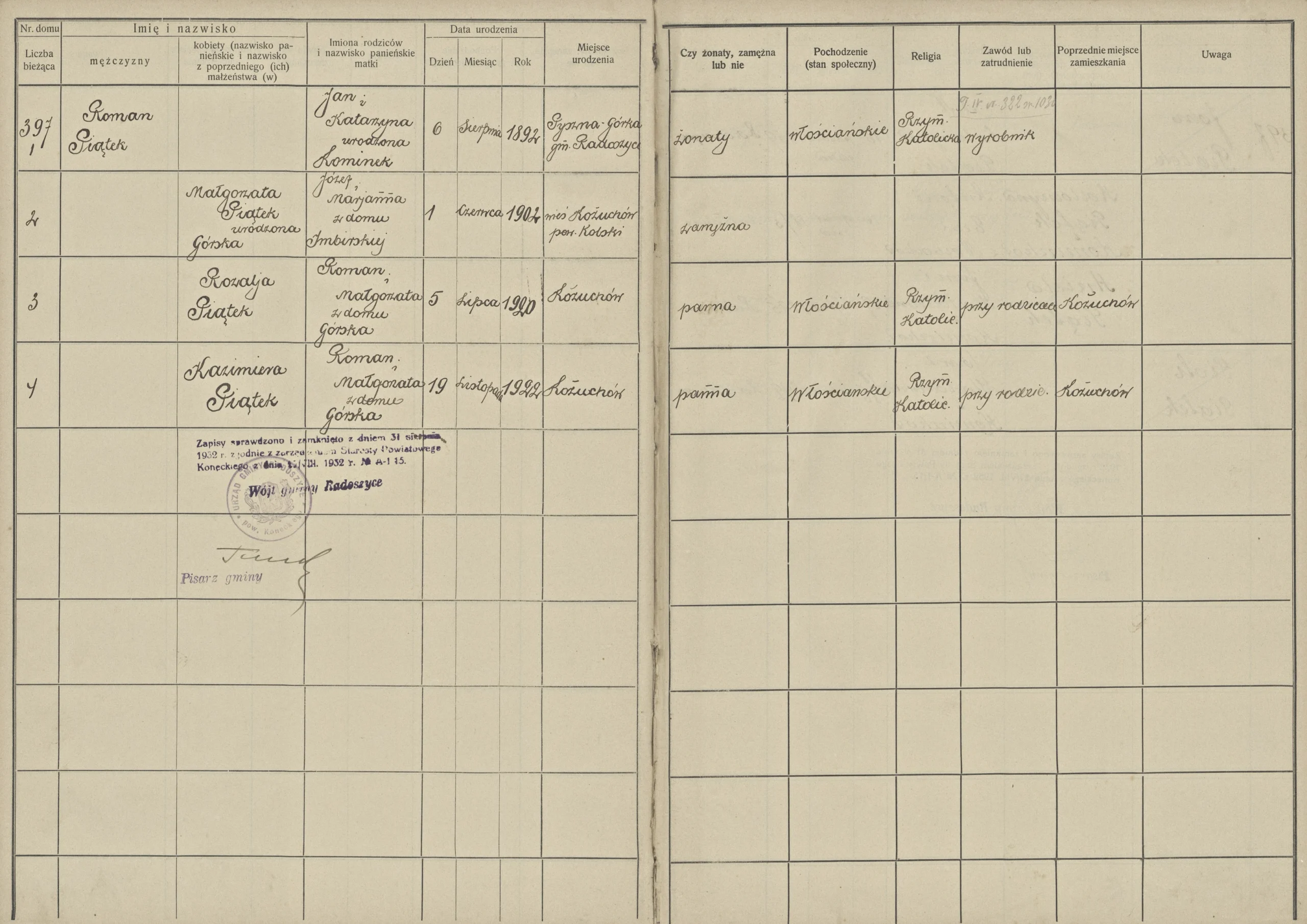
What the entries tell us
- Parents and a maternal maiden name
- Roman’s parents are entered as Jan and Katarzyna, with Kominek recorded as his mother’s maiden name. Małgorzata’s own maiden name, Górska, opens a second family line. Different columns record the woman’s maiden name and her mother’s maiden name; do not confuse them.
- Birth details to test against original records
- The entries appear to give Roman’s birth as 6 August 1892 and Małgorzata’s as 1 June 1902. Roman’s birthplace is entered as Górna Górka in the Radoszyce commune; Małgorzata’s as Kożuchów in the Koło district. These are leads for birth or baptism searches, not substitutes for the original entries.
- Children and the family connection
- Rozalja Piątek, using the recorded spelling of the given name, appears with a birth date of 5 July 1920; Kazimiera Piątek with 19 November 1922. Both entries name Roman and Małgorzata née Górska as parents and give Kożuchów as the birthplace.
- Life beyond names and dates
- Roman’s occupation is wyrobnik, a labourer. The daughters’ employment column says przy rodzicach, meaning with their parents. Roman Catholic religion and social-background entries provide context for selecting and interpreting other sources.
- A closure stamp is not a moving date
- The stamp states that the entries were checked and closed on 31 August 1932. That is an administrative action on the register, not evidence that everyone moved away, died or ceased living at this address that day.
A Rzeszów residence registration card: family details and address history
Document example 02 / Residence card / Rzeszow
A family card with space to follow later moves
This card names Franciszek and Aniela Paluszak and lists two children. Its headings distinguish birthplaces, legal residence, identity documents, military obligation and nationality. The accompanying address-history scan shows how a card could record moves and changes within the municipality.
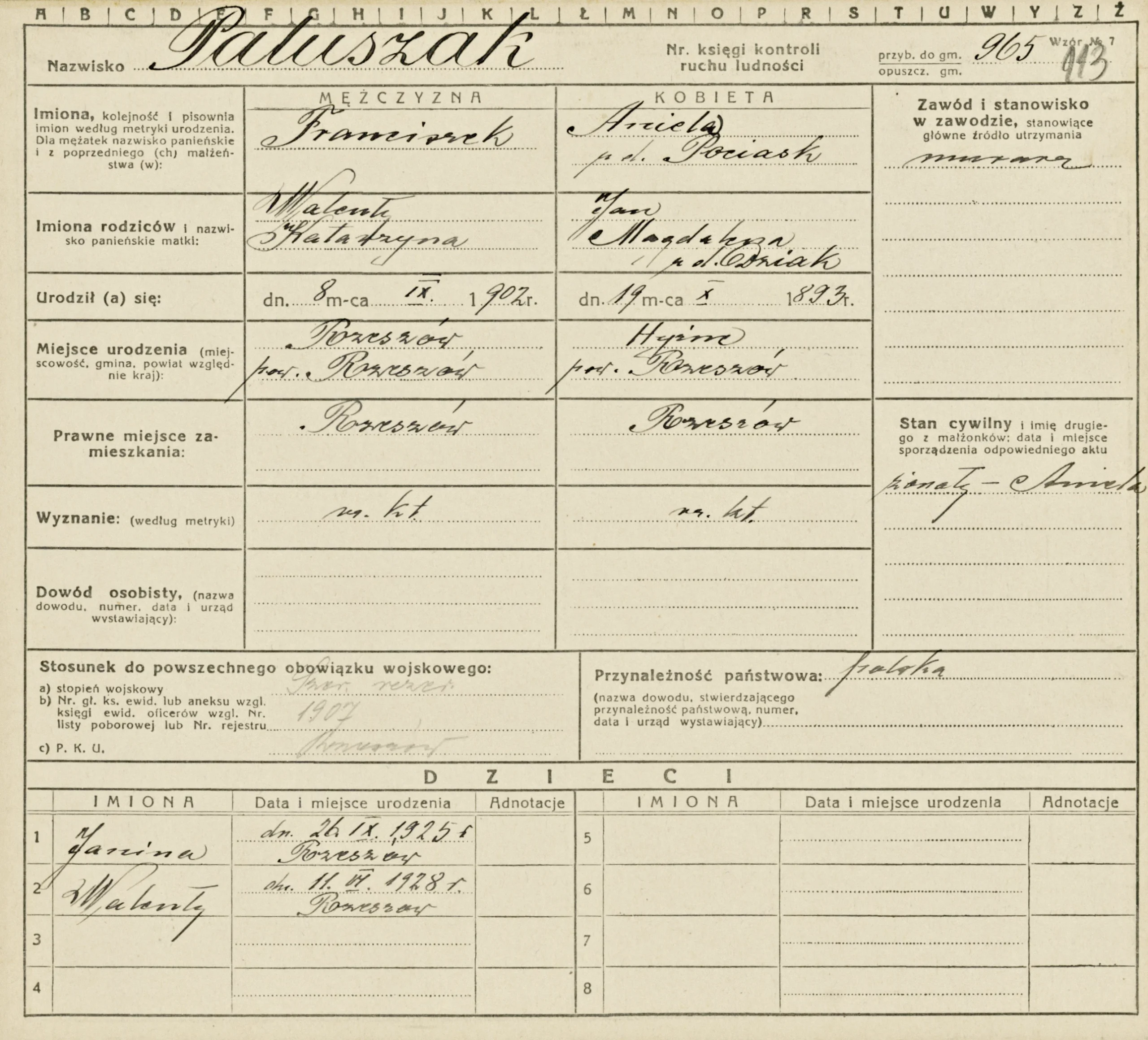
What the entries tell us
- Birthplaces lead to different searches
- Franciszek’s birth entry appears to read 8 September 1902, Rzeszów. Aniela’s appears to read 19 October 1893, Hyżne, in the Rzeszów district. A common later address does not mean that spouses were born in the same parish.
- Children identify another generation
- The lower panel lists Janina, apparently born 26 September 1925, and Walenty, apparently born 11 April 1928, both in Rzeszów. Compare these readings with original birth entries before incorporating exact dates into a family tree.
- Parents, religion and work
- The card has separate parent-name entries for each adult, Roman Catholic religion abbreviated as rz. kt., and murarz in the occupation field. Aniela’s maiden name is also entered, but its handwriting should be checked against another source before adopting a definitive spelling.
- Nationality and military fields need their own evidence
- The nationality field reads polska. This is evidence of what the office recorded about the people on the card, rather than a determination of a descendant’s current citizenship. The military-obligation section is a further research lead, not a complete service history.
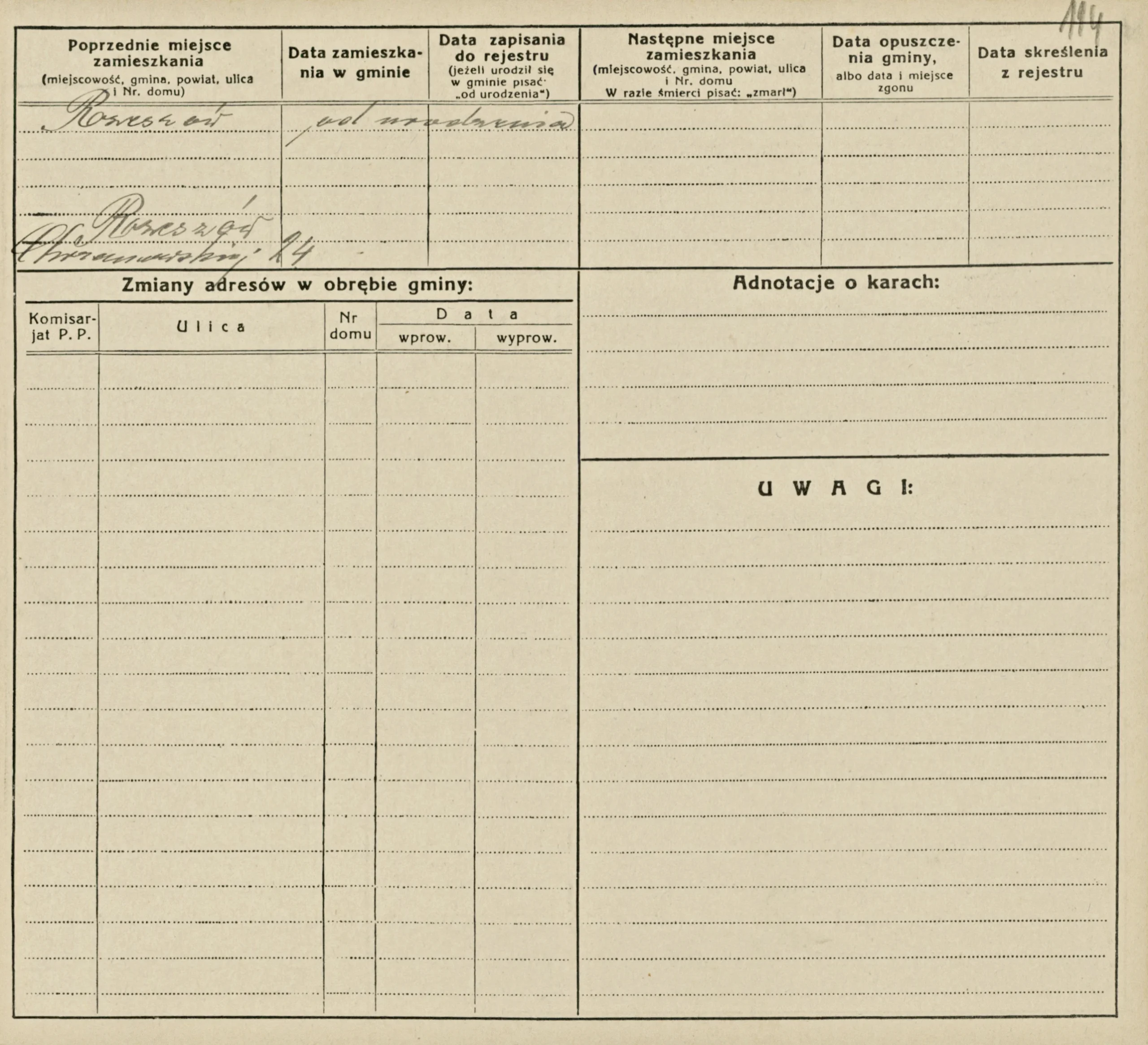
What the entries tell us
- From birth is not a registration date
- The phrase od urodzenia means “from birth”. Its meaning follows the column in which it appears. A date of arrival, a date of registration and a birth date should remain separate events in a research timeline.
- An address worth investigating
- The lower handwritten address appears to refer to Przemysłowa Street, number 24, in Rzeszów. Treat this as a provisional reading: compare the full card and contemporary street records before locating the property on a modern map.
- Blank fields do not prove no later events
- The spaces for next residence, departure, local address changes and penalties are largely unfilled in this image. A blank is not proof that the family never moved, that no further record existed or that every administrative event was entered here.
Where the registers are held
A search follows the municipality, the historical jurisdiction and the dates. Surviving registers are in a state archive or still with a municipal office. Civil registry offices hold civil-status records, not residence registers, and the 100-year rule for birth registers does not apply to them.
The two examples above come from different collections: Akta gminy Radoszyce at the State Archives in Kielce and Akta miasta Rzeszowa at the State Archives in Rzeszów. Their different layouts show why the type of collection matters as much as the surname. Digitisation and access differ between archives, and parish household lists are a separate source.
Residence registers and Polish citizenship
A residence register helps to establish identity, family relationships and what an official recorded about nationality. Residence, birthplace and ancestry are not the same as citizenship, and a single card does not show later changes of nationality or a descendant’s legal position today. For British families, these entries are one part of the documentary evidence; see our guide for British families researching Polish citizenship.