Andrzejki: Poland’s Night of Wax and Fortune-Telling
Andrzejki is the Polish custom of telling fortunes on the evening of 29 November, the eve of St Andrew’s Day. The best-known game involves pouring wax through the hole of a key into cold water and looking at the shadow it casts. Moving shoes towards a door is another favourite. The games once asked who would marry next. At many gatherings today, the fun is in seeing what people can make of the results.
The Polish name comes from Andrzej, or Andrew. An invitation to an andrzejki party usually means an evening of games or dancing. If someone in the family is called Andrzej, you might also hear about his imieniny, or name day. It helps to know which occasion the person sending the invitation has in mind.
When is Andrzejki in Poland?
The traditional night is 29 November, leading into the feast of St Andrew on 30 November. That explains why both dates appear in English accounts. If you are going to a dance or school event, use the date on the invitation. An organised gathering can take place at the weekend even when the eve falls in the middle of the week.

If the story has come down in English as ‘the St Andrew’s party’, keep that wording alongside the Polish term. A club secretary might have printed one language on the programme and used the other in conversation. Search the name of the venue as well as the name of the evening. If you find a programme, its list of bands, organisers or participating associations may explain how a family came to attend.
There is a useful comparison for British readers. Scotland marks St Andrew’s Day on 30 November, with its own national and community traditions. Poland shares the saint’s name and feast date. The Polish custom described here centres on the evening before and its fortune-telling games. Hearing about the Scottish celebration gives you the date, while hearing about wax and shoes tells you which custom the speaker means.
The eve falls near the start of Advent. In accounts of older village life, it marks a point in the late-autumn calendar when young people asked questions about marriage and the year ahead. Modern parties can keep that timing even when the people around the table treat it simply as a reason to get together.
How does Andrzejki wax pouring work?
The familiar version uses a key with an opening, a bowl of cold water and melted wax. The wax goes through the opening and hardens on contact with the water. Lift the piece and hold it between a light and a pale wall. Rotating it changes the outline. A shape that looks like a bird from one angle may look like a ship from another.

The shadow is the part everyone can read together. A ship could prompt a story about travel. Two people can see completely different things in the same piece, and families can assign their own meanings. For an evening with young children, an adult can handle the hot wax and let them take over when it is time to look at the shadows.
If an older relative remembers only a bowl and candle ends, ask who held the key, where the group met and what they did with the wax afterwards. A kitchen, school hall and parish room suggest quite different occasions. Two relatives can remember the same gathering from opposite sides of the room and each supply details the other missed.

Why do people line up shoes by the door?
In one common version, participants take off one shoe each and make a line. The shoe at the back is moved to the front and the line advances towards the door. The owner of the first shoe to cross the threshold is said to be the first to marry. The order can be decided before the game, or the players can leave it to whoever set the shoes down first.
The game has a clear finish and needs very little equipment, which makes it easy to repeat in a different house or a school corridor. If people remember the finish but disagree about how the shoes got there, they may be describing different versions of the same idea. A grandmother may remember only girls playing, while her grandchildren remember the entire class taking part.
Other divinations used whatever the household had to hand. Ethnographers recorded games involving food and animals, where an animal’s choice was taken as an omen. In an 1875 verse by Klemens Junosza, a dog takes a morsel offered by one of the young women. The poem gives a period example of how the game was imagined. The point of comparing those accounts is to see how much the custom could vary. A memory about a dog or a morsel of food can fit the occasion even if the family next door remembers only wax.
Why were the fortunes about marriage?
Older accounts often describe unmarried young women trying to find out when they would marry or what their future husband might be like. Marriage could affect where a person lived, how they worked and which household they joined. An evening of divination put those questions into a game that could be shared among friends.
There was also a related custom called Katarzynki, linked to the eve of St Catherine’s Day and associated in historical accounts with young men’s marriage fortunes. It falls earlier in November. The pairing is useful when reading a regional account that describes different groups taking part on different nights. The best-known public celebration today is Andrzejki, where organisers can invite everyone and use the older marriage questions as jokes.
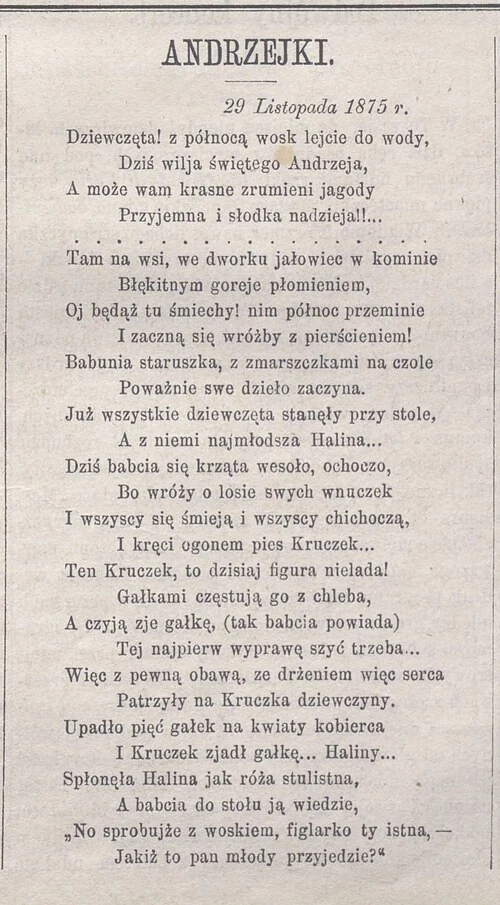
A museum description usually gives a place or a period for the version it records. Keep that context when telling the story. A custom collected in one district is evidence of what people described there. A grandmother’s account, a school programme and an ethnographer’s description can all show different ways the evening was kept.
How families keep Andrzejki in Britain
A family can move the party to a convenient weekend, replace a candle with a lamp for reading shadows and let children predict jobs, holidays or adventures instead of marriages. The recognisable parts are the late-November evening and the household objects turned into games. An older invitation might use Andrzejki to mean the whole dance, even if the paper says nothing about wax.
If you are going to your first gathering, ask whether it is a dance, a children’s party or a night at someone’s house. If you are hosting, one or two games give guests enough to try. Keep any family story about how a particular relative played separate from the version you decide to use this year. The differences can be the most interesting part of the conversation.
Andrzejki can sit next to other traditions in a family calendar. In Britain, a family might remember the November dance separately from its Polish Christmas traditions. Ask which gathering came first, which language invitations were printed in and which relatives travelled to join. A remembered custom becomes more useful when there is a place, date or group attached to it.
What an old Andrzejki invitation can tell you
Start with the small print. An invitation can give a hall address, the name of an organiser and a date. A photo can show which people attended together. A message written on the back may identify the relative who kept it. Scan both sides and preserve the spelling of each Polish name. Give a spoken recollection a separate note with the date of the conversation.
For example, imagine a family in Leeds has a dance ticket marked Andrzejki and a surname handwritten beside the name of the hall. The ticket locates an event. A relative’s letter might show that the surname belonged to the friend who sold the tickets. A second letter or a marriage document could be the better clue to the family’s town in Poland. Record each connection at the strength the material supports.
If a Polish place and a person emerge, those details can guide research in civil, parish or residence records. Our family history service traces the agreed line, identifies the sources behind each connection and explains the findings in English. Start with the material that names people and places, alongside the story of the evening itself.