Polish Army in France
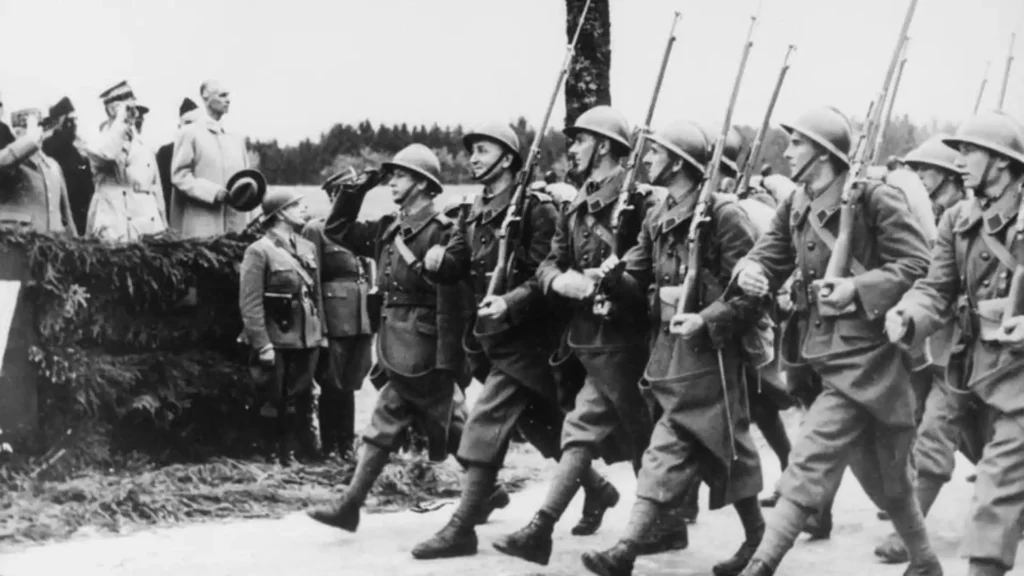
The Polish Army in France was raised in the winter of 1939-1940 from soldiers who had escaped after the defeat of September 1939 and from Polish emigrants already living in France. This article covers how it was formed, where it fought in 1940, what happened to its soldiers after the fall of France and where their records are held.
Formation of the Polish Army in France
After Germany and the Soviet Union invaded Poland in September 1939, tens of thousands of Polish soldiers escaped through Romania and Hungary. The Polish government-in-exile under General Władysław Sikorski re-formed the army in France with the agreement of the French government, and by 15 June 1940 it numbered 84,461.

How many Polish troops fought in France?
By 15 June 1940 the Polish Army in France numbered about 84,000. It was commanded by General Władysław Sikorski, Prime Minister of the Polish government-in-exile and Commander-in-Chief.
Polish units fought at Narvik in Norway and in the Battle of France in May and June 1940. The 10th Armoured Cavalry Brigade under General Stanisław Maczek fought in Champagne and Burgundy and was surrounded near Montbard, where it destroyed its equipment.
Units of the Polish Army in France
The main formations were the 1st Grenadier Division, the 2nd Infantry Fusiliers Division, the 10th Armoured Cavalry Brigade and the Independent Podhale Rifle Brigade, which fought at Narvik in Norway from 28 May to 4 June 1940. The 3rd and 4th Infantry Divisions were still forming when France fell, and the Independent Carpathian Brigade was in Syria. Polish airmen flew mostly in French units; only one fighter squadron, GC 1/145, fought as a Polish unit.

Two descriptions of the same camp can concern entirely different groups. This photograph records a visit by a mission. A relative’s album marked Coëtquidan gives a place to investigate, but identifying a posted soldier calls for a name and unit as well as the camp label.
After the French armistice, between about 20,000 and 35,000 Polish soldiers and airmen were evacuated to Britain. The ground troops were reorganised in Scotland. The airmen joined the RAF, and Polish pilots of Nos. 302 and 303 Squadrons flew in the Battle of Britain.
The Polish Army in the Battle of France
During the Battle of France in 1940 the 1st Grenadier Division, part of the French 4th Army, held a sector in Lorraine. On 17-18 June it defended the Marne-Rhine Canal near Lagarde and lost up to half of its men. On 21 June its commander, Bolesław Duch, ordered the division to break up into small groups and make for Britain. The 2nd Infantry Fusiliers Division, surrounded near Belfort, crossed into Switzerland on 20-21 June and was interned there.
How to find the records of Polish soldiers in France?
Personnel files of soldiers of the Polish Army in France who did not later serve under British command are held by the Service historique de la Défense (SHD) at its military personnel archive centre in Pau. For men who went on to serve under British command, the individual file is held by the UK Ministry of Defence.
The Polish Institute and Sikorski Museum in London holds war diaries and other records of the Polish forces in the West.
Other archives
In Poland, the Central Military Archive in Warsaw holds personnel records of the pre-1939 Polish Army, which often show a soldier’s service before he reached France. The National Digital Archives (NAC) holds photographs of the period.
Soldiers taken prisoner by the Germans in 1940 may appear in the records of the former International Tracing Service, now the Arolsen Archives in Bad Arolsen, Germany. Our military records research works through these French, Polish and German sources for a named soldier.