Cemeteries in Poland
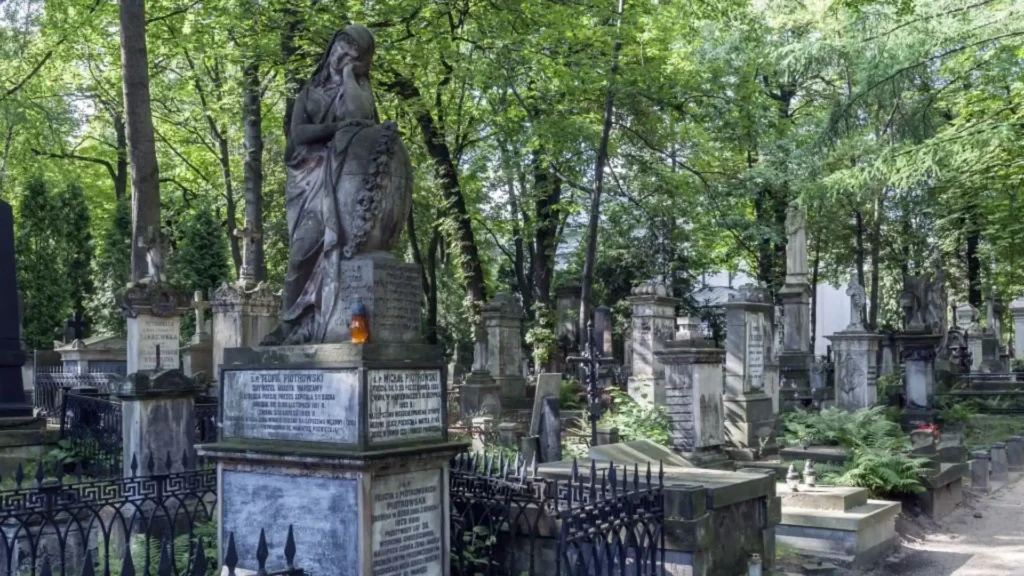
Finding a relative’s grave in Poland usually starts with identifying the right person and locality, not choosing a cemetery from a list of famous burial grounds. Wherever you live, begin with family papers, a death notice or an inscription photograph. Record the spellings and dates exactly as they appear, then compare them with death, parish and burial evidence before arranging a search or a visit.
How to find a grave in Poland?
Start with the full name, an approximate date of death and the town or parish where the person lived. The death entry in the civil or parish register usually names the parish, and the burial will be in the register of that parish or of the municipal cemetery administration (zarząd cmentarza). Our search starts from the death record and then checks the cemetery burial register, the online grave locators many Polish cemeteries now publish and the Geneteka indexes for the plot.
Notable Polish cemeteries
- Powązki Cemetery, Warsaw: Established in 1790, Powązki is one of the oldest cemeteries in Poland and serves as the final resting place of many notable Polish figures, including writers, artists and national heroes.
- Rakowicki Cemetery, Kraków: Opened in 1803 as the city’s main cemetery; the painter Jan Matejko is among those buried there.
- Łyczakowski Cemetery, Lviv: Although now located in Ukraine due to border changes after World War II, the historic Łyczakowski Cemetery is a significant part of Polish cultural heritage. Many Polish families from Lwów are buried there.
Need help finding the grave of your ancestors?
We search registry office, cemetery and State Archives records to identify where your ancestor was buried. The first step is usually the death record: our vital record search finds the entry, and it identifies the parish and cemetery.
How long are graves kept in Poland?
Under Polish law a grave may not be reused for another burial until 20 years have passed. After that, anyone can prevent reuse by lodging an objection and paying the burial fee, which secures the grave for a further 20 years and can be renewed. Longer terms can be agreed with the cemetery.
The 20-year rule does not apply to brick tombs built for more than one person or to urn graves, and graves of historic or artistic value may not be reused. Fees are set by each municipality or parish cemetery.
Catholic Cemeteries in Poland
Most Polish cemeteries are Catholic, run either by a parish or by the municipality. The parish office keeps the burial register and the list of grave leases, so it is the place to confirm a plot. The best known is Powązki Cemetery (Cmentarz Powązkowski) in Warsaw.
Finding an ancestor’s grave in Poland: what we check
We start from the death or burial entry in the civil or parish register, which normally identifies the parish and so the cemetery. We then check the parish or municipal burial register for the plot, the cemetery online grave locator where one exists, and the indexes on Geneteka and FamilySearch. Where a grave has been reused or cleared, the burial register may still record where the person was buried.
Evangelical Cemeteries in Poland
Lutheran and Reformed cemeteries are most common in the former Prussian lands and in towns with German-speaking communities. Many in western and northern Poland were neglected or cleared after 1945. The largest is the Lutheran cemetery in Warsaw (Cmentarz Ewangelicko-Augsburski).
Jewish Cemeteries in Poland
Jewish cemeteries in Poland record centuries of Jewish life. The most famous among them is the Okopowa Street Jewish Cemetery in Warsaw, one of the largest Jewish cemeteries in Europe. Many were destroyed during and after the Second World War, and in many towns no headstones survive.
Cemetery records online
Gravestones and burial registers give dates of birth and death and family relationships, and sometimes an occupation or military service.
Several online platforms such as BillionGraves and Find A Grave allow users to search a worldwide database of graves, and include many entries from Poland. Many Polish municipal and parish cemeteries also publish their own online grave locators.
Plan a grave search from abroad
- Record the deceased person’s full name, possible variants and approximate date of death.
- Distinguish the last known home from the place of death and the burial place; these may be different.
- Use a photograph or database entry as a lead, then ask the relevant cemetery or parish what evidence it holds.
- Keep the inscription, burial information and civil death record as separate sources, and compare their details.
Before travelling, confirm the location and access arrangements. Our cemetery records guide explains how burial evidence fits into a wider family search.