How to Find Polish Census Records - Years 1921, 1931 and Earlier
Polish census records and local resident lists can reveal much more than a name: a birthplace, an occupation, an address, relatives and clues to a family’s movements. For descendants researching from Britain, these details can connect a place remembered in family papers with the Polish records behind it. Our family history research service follows those connections and explains the discoveries in English.
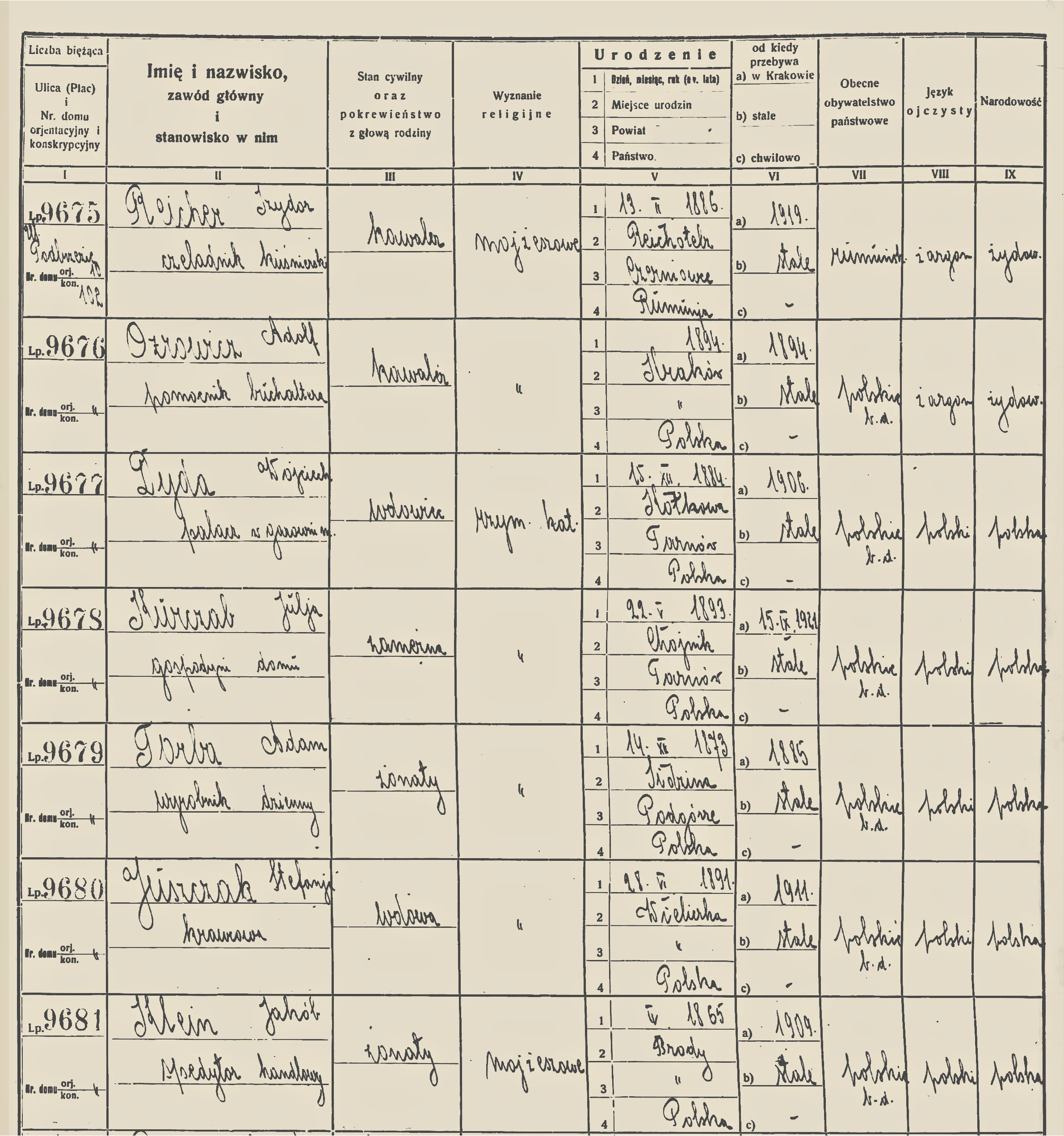
A Kraków resident list: nine columns of family-history clues
Document example / Kraków / People, places and occupations
From one entry to a family’s earlier home
This page brings together personal details and the places from which residents came to Kraków. Reading the columns together gives us several routes to follow: a birth or baptism entry, a marriage, a previous home, an address in the city or a connection with a trade.
What we can discover in these columns
- Names, occupations and addresses
- The first columns record the street and house numbers, then the person’s name and main occupation. The top visible entry includes czeladnik kuśnierski, a furrier’s journeyman. Such details help distinguish people with similar names and place them in the working life of the city.
- Marital status and family position
- The form asks for civil status and relationship to the head of the family. Entries include kawaler (unmarried man), wdowa (widow), zamężna (married woman) and żonaty (married man). These terms help frame a search for marriage records, spouses and earlier family events.
- Birth details pointing beyond Kraków
- The birth column has separate fields for date, locality, district and country. The entry for Jakób Klein near the bottom gives 1865 and Brody. A birthplace like this can take the investigation from the city where a person lived to the community where their life began.
- When the person came to Kraków
- The heading od kiedy przebywa asks how long the person has been in Kraków, with separate permanent and temporary residence fields. A recorded arrival year creates a useful bridge between the earlier locality and the person’s life in the city.
- Religion and the route to family records
- The religious-affiliation column includes mojżeszowe, indicating the Jewish faith, and rzym. kat., Roman Catholic. Along with a birthplace, these entries help identify the relevant civil, religious or community records.
- Citizenship, mother tongue and nationality
- The last three columns ask different questions: obecne obywatelstwo państwowe (current state citizenship), język ojczysty (mother tongue) and narodowość (nationality). Reading them separately gives a fuller picture of how residents were recorded in a diverse city.
A route back to a birth record
A name, birth year, birthplace and religion give us a focused starting point for a civil or religious record search. A corresponding birth entry may add parents’ names and connect the census or resident-list entry with an earlier generation.
A route through the city
An address, arrival entry and occupation can be compared with residence registers, directories and other local material. Together, these sources can help explain where a relative lived and how their life in Kraków developed.
One entry gives an arrival date of 15 April 1924. Each date belongs to its column: a date of birth, a date of arrival and the date of the list record different events. A recorded move is a fixed point from which earlier and later addresses can be traced.
What information can be found in Polish censuses?
What a census record contains depends on the year and the type of record. A surviving personal return or local list may give names, ages or dates of birth, birthplaces, occupations, marital status, religion and addresses, and some forms add relationships within the household, citizenship, language or length of residence. As the Kraków example shows, the printed headings deserve as much attention as the handwriting.
This matters when a British document gives only an approximate birthplace or an anglicised surname. A Polish entry can supply the locality and personal details that connect the family’s later life in Britain with the earlier records.
What is a census called in Polish?
Spis ludności is the Polish for a population census or list, and spis powszechny means a general census. Two related local sources are the księgi ludności (population registers) and księgi meldunkowe (residence registration books). They follow a person or household over years, adding a sequence of addresses and family events to the single moment a census records.
Research your family through census and residence records
Find the right locality and source
We use the names, places and family papers you already hold to identify relevant census, resident-list and household collections. Historical place names and administrative boundaries help determine where to look.
Read the evidence in context
We decipher entries, explain the relevant record details in English and compare names, occupations, birthplaces and family relationships across documents.
Follow the next generation
A birthplace can lead to a birth or baptism entry; marital status can guide a marriage search; household connections may help identify relatives. We follow the evidence within the agreed family line and research time.
Receive a clear report
Your report brings together the records found, source references, digital copies where available and an explanation of the family-history connections.
Polish census years and the records behind them
Poland’s changing borders and governments produced several kinds of population evidence. National census results describe the population as a whole; the named entries used in family history come from surviving personal lists and local records. Which ones exist depends on the locality and the period.
1921: the first census after independence
The first general census of the restored Polish state was taken on 30 September 1921. Surviving local material, including Kraków’s digitised collection, can provide detailed personal evidence.
1931: a second national snapshot
The second general census was taken on 9 December 1931. Published results offer demographic and occupational context. For named-person research, we investigate the local archival sources available for the period.
Earlier censuses and population lists
Sources from the Austrian, Prussian and Russian partitions can take a family investigation further back. Kraków’s archive also describes earlier city censuses and population lists from the eighteenth century.
Post-war family movements
For relatives who moved after the war, residence and registration records can help connect an earlier home with a later address. We use the relevant local collections alongside the wider historical context of post-war population change.
1921 Polish census records: the Kraków collection online
The National Archives in Kraków (Archiwum Narodowe w Krakówie) has put its 1921 city census online, and also describes the earlier Kraków and Podgórze censuses that survive. Linking entries from different years shows changes in a family, its occupations and its moves around the city.
A census entry is rarely the end of a search. It can lead to a Polish birth record, a marriage, a residence register or a passport and identity application, and these add parents, relatives and places.
1931 Polish census records and family research
The second general census was taken on 9 December 1931. Its published results describe the population, language, religion and occupations of each community, which gives context for the place a family lived before the war. For a named person, the search turns to local records for that town and period, especially municipal population and residence registers.
The Kraków archive holds personal census books for 1921, while for 1931 it describes statistical sources only. For a Kraków family in the 1930s, residence registers, civil or religious records and address material take their place.
Polish census records online: finding a named ancestor
Some Polish census material is online, such as the digitised 1921 Kraków census. For other collections the catalogue description is online and copies come from the holding archive. A search therefore starts with the locality and the period, and finding the right collection is what connects a surname with the documents.
Connect the British clue with the Polish place
A birthplace in a British certificate, service paper or family letter can identify the town or parish to investigate. We compare historical spellings and boundaries with the family’s dates.
Identify the collection and access route
We check the town’s census and local population holdings, including the catalogue descriptions and scans in Szukaj w Archiwach. Relevant material can be organised by locality, street, year or volume.
Match the person across records
We compare surname variants, age, birthplace, occupation and relatives. Matching these details helps connect a resident-list entry with the person in your British family documents.
Follow the discovery further
A new birthplace, spouse or address gives the next research direction. We explain the connections in English and include source references and digital copies where available.
Our Polish family history research service covers finding the sources, reading the entries and following the connections within the family line and research hours you choose.
Where are Polish census records held?
Named personal records are in state archive collections, municipal records or local administrative files. The Polish State Archives catalogue lists digitised collections and describes other holdings. Statistics Poland (GUS) and its library publish the census results, which describe a locality’s population.
A local personal list identifies residents; a statistical table describes a population. Parish household books and population registers add a further view of the family, read alongside birth, marriage and death records.
Using census details to trace Polish ancestry
The Kraków sheet records birthplace, state citizenship, language and nationality in separate columns, and each should be read on its own terms. For a citizenship question, these entries are evidence within a separate legal assessment; a nationality label is not a legal conclusion.
For family history, the next steps are the birth entry, the parents, the marriage and the household’s later addresses.
Further reading
National Archives in Kraków: the digitised 1921 city census and earlier population sources. Statistics Poland: the 1921 and 1931 national censuses. Szukaj w Archiwach: catalogue descriptions and digital copies. These sources explain the collections and census history; the example’s personal details are read from the reproduced document.