Australian Naturalisation Records for Polish Families
Names, dates and belonging
One certificate can help put a life in order.
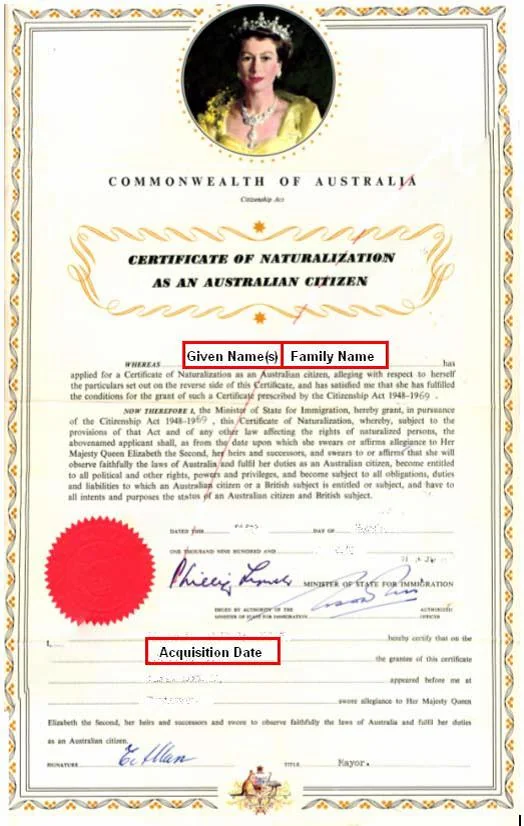
A naturalisation document may add a date, an earlier name or a birthplace to the family account. Read it alongside the rest of the evidence to understand which person and event it records.
See the clues worth followingAustralian naturalisation records can help connect a Polish-born ancestor with the family they established in Australia. An application, declaration or certificate may add evidence to a name, date or earlier place already known at home. Each document needs to be identified by its purpose: applying for naturalisation and receiving a certificate are different events.
We use the family-history clues in Australian papers you already hold to investigate an agreed line in Polish records. If your question concerns the effect of naturalisation on a Polish citizenship claim, that requires a separate eligibility assessment. The archival evidence and the legal interpretation should remain distinct throughout the investigation.
What your family papers may reveal
Know the document
Distinguish an application, an oath and a certificate.
Identify the ancestor
Compare names, age and family details before accepting a match.
Follow the birthplace
Use a supported locality to direct the earlier Polish research.
Where Australian naturalisation records are held
The location of an Australian naturalisation record depends partly on the period and jurisdiction. National Archives of Australia guidance describes Commonwealth records from 1904 alongside earlier holdings for Victoria and South Australia. Earlier records for other colonies may be in the relevant state archive. A present-day Australian address does not identify the right historical record holder by itself.
Record where the person lived at the time of the event, not only where descendants live now. A move between states can explain why an expected record is not found in a particular collection. The approximate period also helps distinguish an older colonial process from later Commonwealth administration without assuming that every record is held in Canberra.
Keep the catalogue description and any collection information with the copy you already have. The archive’s name identifies a repository; a file’s title and context explain what it concerns. Knowing both helps avoid confusing an index card with the actual case file, or a later reference to naturalisation with the original event.
Naturalisation applications, oaths and certificates
A file can contain several stages of an administrative process. The National Archives describes applications, declarations, certificates, oaths and correspondence among naturalisation material, with contents varying by period. Read the heading and wording of each page before assigning its date to a family timeline. The date on a letter is not automatically the date on which citizenship was acquired.
Use an event-by-event note: the person, the document, the stated action and the date attached to it. If you have only a later transcription or a cropped certificate image, identify that limitation. A complete copy may clarify whether a date refers to an application, a declaration or the issue of a particular paper.
Historical terminology also needs context. The State Library of Queensland notes that British-subject wording does not necessarily mean a person was born in Britain. Preserve the phrase in your transcription and distinguish it from birthplace. A Polish family history should not acquire a British-born ancestor simply because a later record uses a nationality term unfamiliar to the reader.
Match the naturalised person with the Polish ancestor
Compare the record with the family member’s spouse, age, Australian passenger arrival details and known addresses. A surname alone is rarely enough to distinguish people who migrated in the same era. Where a name has several spellings, keep a note of each version and the source that uses it. Do not replace the original wording with a preferred family spelling before the identification has been tested.
An applicant-supplied detail can be useful without being infallible. The State Library’s research guidance highlights the need to corroborate statements in these records. Compare a remembered voyage or birth date with the other papers you hold. When dates differ, the discrepancy is something to investigate, rather than a reason to choose whichever entry gives the neatest tree.
A good identification note explains why a particular file belongs to the person in your family. It may combine a spouse’s name, an address and a plausible arrival. It should also state any unresolved difference. This makes the reasoning visible when the next stage of research moves from Australian sources into Polish records.
What the file can tell you about the family
Look for the details that connect the person with other people and places, rather than only the certificate number. The information available depends on the document and period. A stated residence, a relative or a biographical detail can be a lead, but do not assume every file names parents or gives an exact Polish village.
Preserve the distinction between a person named in the file and someone proven to have a particular relationship. A child, spouse or correspondent may appear for a different administrative reason. Record the relationship actually stated and use other evidence to test it where necessary. A list of names is not automatically a documented household or a line of descent.
Suppose a fictional family holds a naturalisation application under one given name and a marriage paper under another. A shared spouse and consistent biographical details might support an identification worth testing. The research question would be how those papers connect to the same Polish family, not whether the similarity alone proves the link. This is an illustrative example, not a completed case.
A missing online result does not establish the answer
An online catalogue and the underlying records are not the same thing. The National Archives describes a Citizenship Index used to help locate records and explains that it is not publicly available in its entirety because it includes material outside open access. An unsuccessful name search should not be reported as a complete investigation of every possible record.
Naturalisation was not compulsory, according to the National Archives, so a record cannot be assumed to exist for every eligible migrant. These two points need to be considered together. A missing search result is not proof that an ancestor never naturalised, while migration to Australia is not proof that they eventually did.
Describe the search that has actually been made: the collection, spelling, approximate dates and result. This is more informative than writing simply no record found. If a citizenship enquiry depends on the event, distinguish the current state of the evidence from a definitive statement about the person’s legal history. Our paid Polish citizenship eligibility assessment considers the family evidence and the questions that require separate assessment.
Follow a birthplace or family connection into Poland
An earlier place may be the most useful genealogical clue, provided its meaning is clear. Is the document recording a birthplace, a previous residence or a country of nationality? Keep the label and entry together. The difference determines which Polish record might answer the next question.
Identify the locality using the date, alternative spelling and nearby places known from the family. A historical Polish place name may refer to more than one settlement or to an area outside today’s Polish borders. The investigation needs an appropriate geographical setting before selecting a parish, registry office or archive.
Once the place and identity are supported, Polish civil and parish sources may establish an earlier relationship. The Australia-to-Poland family research guide explains that connection. A naturalisation paper can direct the enquiry, while the relevant Polish record tests it. It should not be treated as a substitute for every birth or marriage entry in the earlier family line.
Commission a defined family-history investigation
Our family-history research service investigates an agreed line or question in Polish and relevant continental sources. You can provide the Australian naturalisation papers your family already holds as starting evidence. The current offer does not include ordering Australian government files or issuing official conclusions about Australian citizenship.
The written findings explain what the research establishes, with references and copies where available and permitted. A supported identification, a newly documented parent and an unresolved contradiction should be described separately. A report can therefore be useful even when a particular expected record has not survived or the available evidence leaves a question open.
State your objective clearly when commissioning the work. Establishing a grandparent’s Polish birthplace is different from assessing eligibility for Polish citizenship. The first may lead to family-history research; the second belongs with the paid citizenship assessment. Defining the question lets the documents be used for a specific purpose rather than accumulate as an unexplained folder of copies.
Official sources
Sources checked on 28 October 2026. Requirements should be confirmed for the specific record and intended recipient.